Indonesia’s Imperial Highway
As the people of West Papua fight for independence, the Indonesian government is hastening the exploitation of the country’s immense natural resources.
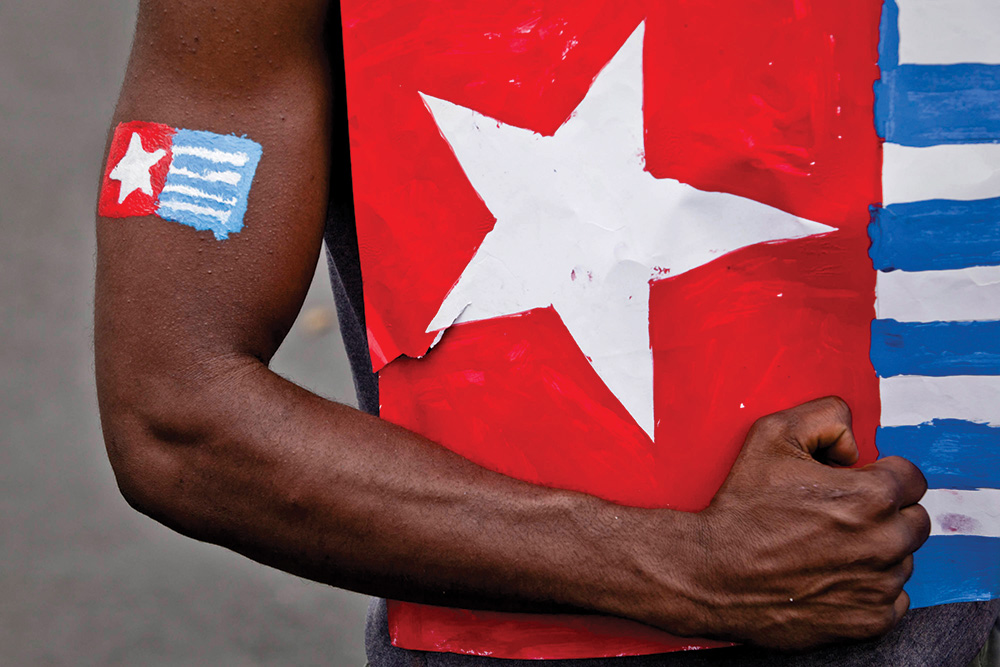
A member of the Papuan Students Alliance bears two paintings of the Morning Star flag during protest against the New York Agreement on the fifty-first anniversary of its signing, August 15, 2013.Getty Images
Last September, laborers returning to work on the Trans-Papua Highway found that much of their heavy equipment had been destroyed overnight, likely by the West Papua National Liberation Army (tpnpb), West Papua’s most prominent armed independence group. As a result, construction was briefly stopped on a stretch of road traversing the Bintang Mountains, close to the Indonesian border with Papua New Guinea. Additional troops were sent to the area, along with other road construction sites considered vulnerable by the Indonesian military.
Such disruptions have become commonplace along the highway, which snakes over more than two thousand miles, tracing the entirety of occupied West Papua.
The occupation of West Papua is now six decades long. After Indonesia won its independence from the Netherlands in 1949, its founding president, Sukarno — a towering figure of the age of decolonization — moved to claim the region for Jakarta. But the Dutch were unwilling to fully relinquish their foothold in Southeast Asia, and they held on to what was then Western New Guinea for thirteen years. Under pressure from the United States, who felt conflict in West Papua would alienate pro-Western elements they were cultivating within the Indonesian military, the Netherlands ultimately authorized West Papua’s handover in 1963; its integration into Indonesia was ratified six years later by a sham un referendum that saw roughly one thousand handpicked Papuans intimidated into voting unanimously against independence.