10 Years Ago Today, the Chicago Teachers Union Strike Changed Public Education
When the Chicago Teachers Union went on strike against Mayor Rahm Emanuel ten years ago, corporate education reform was on the march. The CTU won that strike, beat back the neoliberal Democrats, and turned the tide in favor of public education.
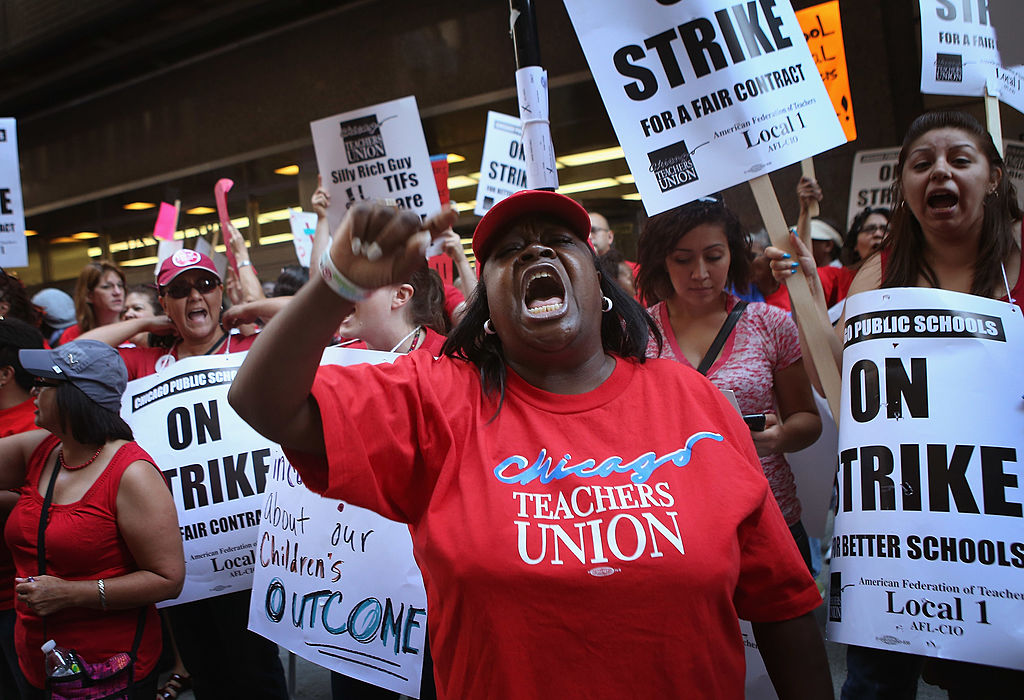
Chicago public school teachers and supporters picket in front of the Chicago Public Schools headquarters, September 11, 2012. (Scott Olson / Getty Images)
Ten years ago, Chicago educators lit the fuse of what eventually became a national teachers’ revolt. Faced with Democratic mayor Rahm Emanuel’s privatizing agenda, over twenty-six thousand teachers, clinicians, and paraprofessionals shut down schools for seven days in September 2012. The Chicago Teachers Union (CTU) won a 17 percent pay raise and increased resources for students, and it stopped a 40 percent increase in health care costs as well as a proposal to peg teachers’ pay to students’ standardized test scores. No less important, the union challenged the accepted truths of corporate education reform, built deep ties with community members, and empowered educators across the city and nation.
Pioneering an approach that has since come to be known as “bargaining for the common good,” Chicago educators demonstrated the power of worker-led unionism that fights with and for the broader multiracial working class. On the ten-year anniversary of the strike, it is useful to assess its historic significance and its impact on subsequent struggles nationwide, most notably on the 2018 to 2019 wave of educator work stoppages that swept red as well as blue states. It is also important to identify some underexplored aspects of the CTU experience, such as the limitations of strikes, the dilemma of sustaining power, and electoral organizing in the wake of strike action. One way to prepare for the struggles ahead is to take a fresh look at what we know — and what we do not yet know — about how Chicago’s militant teachers made history.
The Significance of the 2012 Strike
Successful strikes often seem inevitable in hindsight. But we should not lose sight of just how novel and unexpected the CTU’s work stoppage was in 2012. Jean-Claude Brizard was the CEO of Chicago’s public school system at the time. As he put it — when he resigned in 2013 — “We severely underestimated the ability of the Chicago Teachers Union to lead a massive grassroots campaign against our administration. It’s a lesson for all of us in the [education] reform community.”