Colombia Is Finally in the Midst of a Long-Awaited Opening for Left Politics
With Gustavo Petro and Francia Márquez’s win in its presidential election, Colombia finally has a chance to roll back its decades of violence and inequality stoked by the country’s status as one of the US’s principal allies in the western hemisphere.
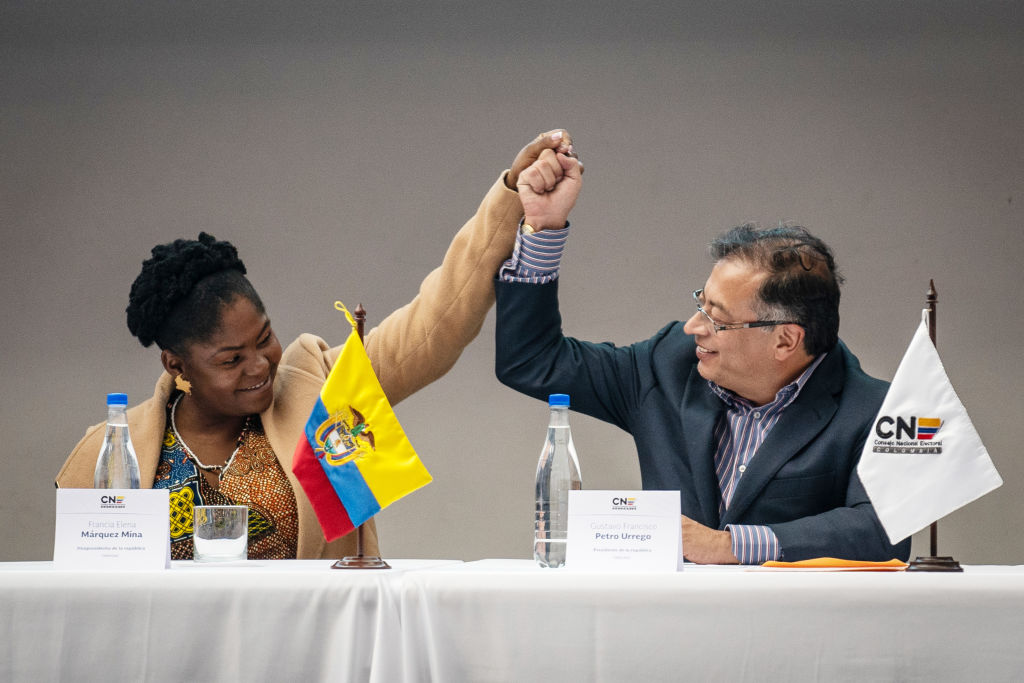
Gustavo Petro, Colombia’s president-elect, and Francia Márquez, Colombia’s vice president–elect, receive presidential credentials at the National Civil Registry in Bogotá, Colombia, on June 23, 2022. (Nathalia Angarita / Bloomberg via Getty Images)
On June 19, Gustavo Petro and Francia Márquez sealed victory in the Colombian presidential race to achieve what once seemed unthinkable: a left-wing governing alliance in the country better known for paramilitarism, the US-led Drug War, and a seemingly endless succession of right-wing political elites in government.
Just as remarkable, the Historic Pact party can count a handful of achievements in its favor before having even taken office: the ELN guerrilla army (the National Liberation Army), which has remained active during the country’s peace process, has agreed to sit down to negotiate demobilization with the incoming government; talks have also begun with Venezuela to reopen the countries’ enormous shared border, to this day a hot spot for armed conflict and symbol of political tensions between the two nations; even former president Álvaro Uribe, the far-right caudillo of Colombian paramilitarism, has met with ex-guerrilla leader Petro to send a message of dialogue and tolerance during this new, uncertain stage of Colombian politics.
The emphasis, of course, is on uncertainty. Petro and Márquez look to chart a course toward lasting peace and demilitarization, redistribution and environmental justice in a Colombia where almost half of the country did not vote for the Historic Pact candidates, where an opportunistic “populist” candidate gave them stiff competition in the runoff elections, and where right-wing Uribismo — currently in the form of sitting right-wing president, Iván Duque — remains deeply embedded in state structures and civil society.