“Turkey Is Reviving Islamic State in Rojava”
Turkey’s invasion of northern Syria is its latest effort to destroy the nascent democracy in Rojava. Where Kurdish-led forces crushed the Islamic State, its fighters are now coming back into the open.
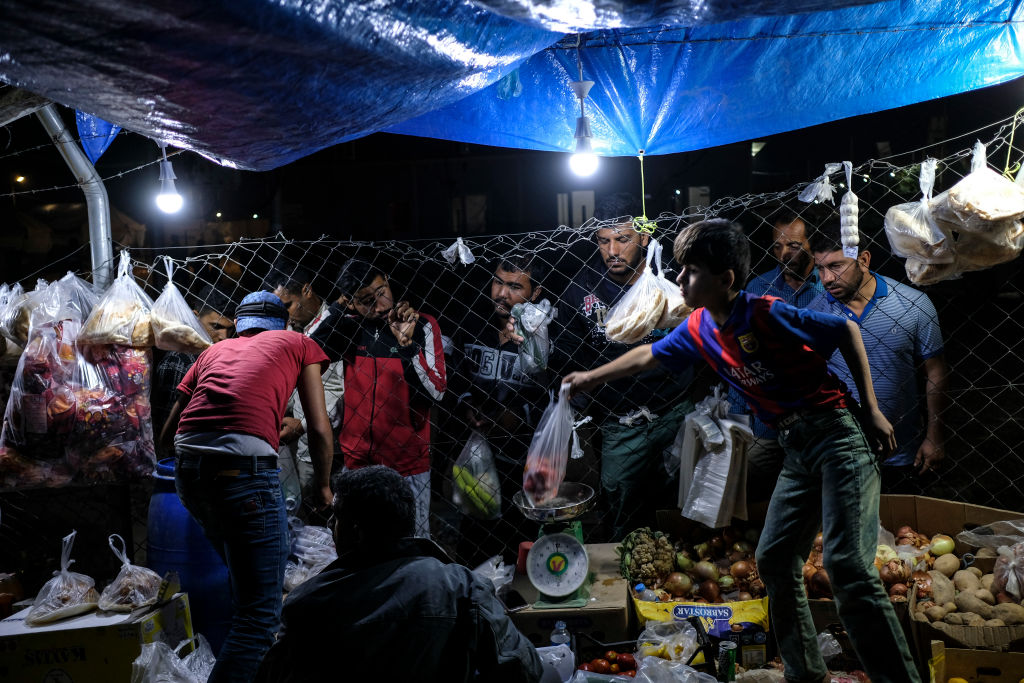
Vendors sell fruits, vegetables, and cooking utilities to refugees outside of Badarash IDPs camp which has continued to swell for Syrian Kurdish refugees fleeing the recent Turkish incursion in Rojava October 24, 2019 in Dohuk, Iraq.Byron Smith / Getty
The death of Islamic State (IS) leader Abu Bakr al-Baghdadi isn’t the end of the Syrian bloodbath — even in the areas IS has long tyrannized. Over the last two years its territory has been radically reduced, including thanks to the People’s Protection Units (YPG) and the Syrian Democratic Forces (SDF) they lead. These Kurdish-led forces have not only resisted IS but created a new form of nonsectarian democracy across northern Syria, known as Rojava. Yet despite al-Baghdadi’s death, Rojava is today again endangered.
This renewed threat to the democratic project in northern Syria is not entirely surprising. In a theater of warfare involving powers such as the United States, Russia, Turkey, and the Gulf States, the survival of Rojava was always at the mercy of a precarious geopolitical balance. When, earlier this month, Donald Trump pulled out the small number of US forces from Syria, he also gave the green light for Turkey’s authoritarian president Recep Tayyip Erdoğan to launch an invasion of SDF-held territory.
The immediate impact of the Turkish invasion has been disastrous, forcing as many as 300,000 civilians to flee their homes. Today, the Turkish-led forces are continuing their attacks even beyond a nineteen-mile buffer zone negotiated with Russia last week, from which SDF fighters have withdrawn. At the same time, the invasion by Turkish and jihadist forces has also allowed the release of IS prisoners, who are now reestablishing their presence in the region.