In Mongolia, Protesters With Empty Stomachs Are Denouncing Empty Promises
Mongolia has seen a wave of protests in response to soaring inflation. The demonstrators have rallied around the slogan “we want to live” — damning the disappointed promises of the country’s postsocialist transition.
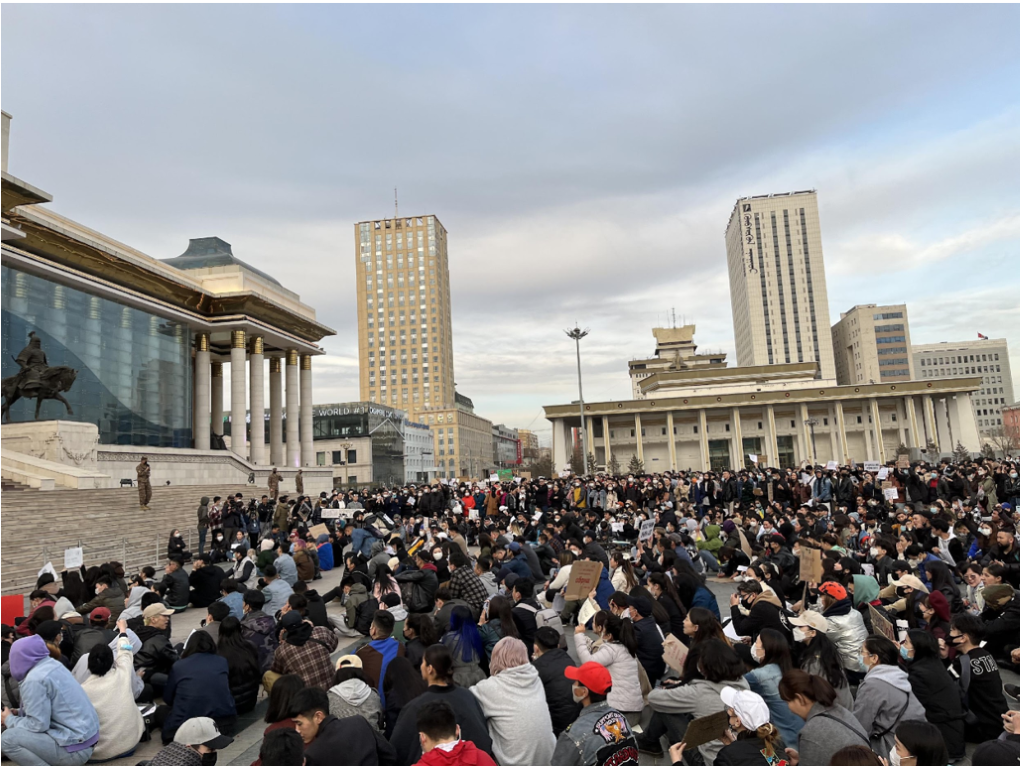
Protesters in Sükhbaatar Square in Ulaanbaatar, Mongolia. (Christian Sorace)
In Mongolia’s capital, Ulaanbaatar, April 7 and 8 saw massive youth-led protests in the main Sükhbaatar Square in front of the parliament building — colloquially referred to as the Government Palace. A common theme of the protests was the absence of any future, voiced in slogans and signs, which read, “We are not living, only surviving”; “We want to live a good life in Mongolia”; “We don’t want this kind of future”; “Is this life?”; and “Mongolia’s economy is a disaster.” Runaway inflation, along with a series of empty promises and insensitive remarks from politicians, brought the protesters into the street. Yet it did not create the underlying sense of economic crisis, which has developed across the past decade.
Prior to inflation, Mongolians would often describe themselves as “living from debt to debt.” On top of these economic complaints, the protesters chanted “Do your job” at a practically empty and unresponsive Government Place. Finally, in the late afternoon on the first day of the protests, justice and internal affairs minister Khishgee Nyambaatar briefly appeared and gave a barely audible speech, which was greeted with boos — and empty plastic bottles hurled in his direction, as he hurriedly returned to the parliament building. Around 2-3 AM, police holding riot shields arrested over a dozen young protesters. A video of police holding and kicking a protester went viral, drawing more people into the square the following day. So did a meme comparing photos of the police’s newly unveiled, anti-riot water cannon, with the antiquated, lumbering water truck used to clean public spaces. On the evening of the second day of protests, Prime Minister Luvsannamsrain Oyun-Erdene emerged and offered vague promises and gestures of sympathy in response to fifteen demands specified by the protesters, which ranged from lowering the price of consumer goods to improved transportation and business conditions.
What originated as an anti-inflation protest also happened to coincide with the Mongolian Economic Forum, which one protester’s sign referred to as “Mongolia’s Disaster Forum.” Together with the prime minister’s empty promises, the economic forum — which showcased the administration’s “New Recovery Policy” to kickstart the economy, in front of representatives from government, foreign embassies, and the private sector — appeared totally disconnected from people’s ordinary lives. Some protesters even held up signs that read “If only I could live like a Parliament member” and “3 million Mongolians [should] eat together,” while others brought and held up everyday items, such as a half loaf of bread, a small piece of meat, a handful of potatoes, and empty plastic bags. The demonstration became a protest against empty stomachs, empty promises, and an empty government palace. While everyone was voicing different aspirations and discontents, there was also a shared feeling of euphoria and solidarity organized around the imperative: we want to live.