Marine Le Pen’s Populist Image Is an Iron Fist in a Velvet Glove
For years, Marine Le Pen has sought to break out of the far-right ghetto by pursuing a "populist popular front" beyond Left and Right. Today, her chosen reactionary themes have become mainstream — and she stands closer than ever to winning the presidency.
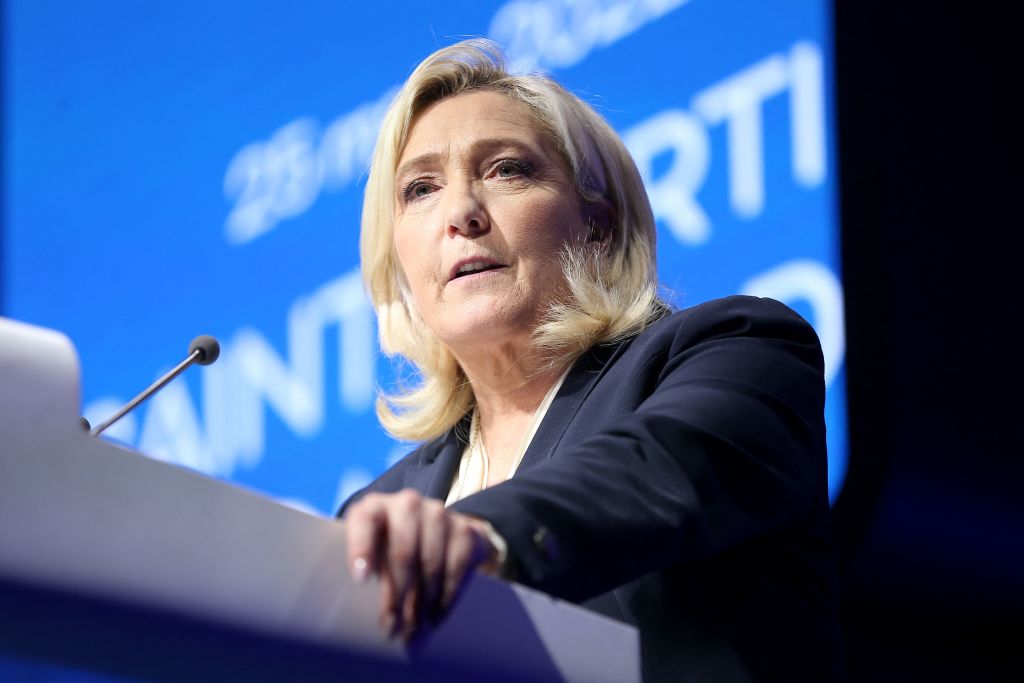
French presidential candidate Marine Le Pen delivers a speech during a campaign meeting in Saint-Martin-Lacaussade, on March 25, 2022. (Romain Perrocheau / AFP via Getty Images)
At first glance, France’s presidential election looks rather like a rerun of the 2017 contest. Most polls suggest that incumbent Emmanuel Macron will top Sunday’s first-round vote before facing, and defeating, Marine Le Pen in the April 24 runoff. In other words, 2022 will be the return leg of the previous electoral matchup between liberalism and nationalism. But beyond this superficial resemblance, the political landscape has profoundly changed since 2017.
Chief among these structural differences is that, as the mainstream has steadily shifted to the Right, the far right is stronger than ever. Before the first round, Le Pen is polling at similar levels to 2017, at around 20 percent. Yet, she fares much better in second-round polls. While she only took 33 percent in the 2017 runoff against Macron, her predicted score if she makes it this time is roughly 45 percent.
Furthermore, the major event that shook the 2022 campaign was the meteoric rise of another far-right candidate: Éric Zemmour. While Le Pen has managed to maintain a lead over him, he initially threatened her chances, bringing her down from her hitherto comfortable place alongside Macron and far above all other candidates. Indeed, beyond its current divisions — the latest iteration of an older divide between traditionalists and modernists, which I will explore in this and following articles — the far right as a whole is showing remarkable electoral strength. Tellingly — and somewhat chillingly — regardless of their relative strength throughout the campaign, the combined voting intentions for Le Pen and Zemmour have remained steadily over 30 percent.