France’s Far Right Is Setting the Agenda Because the Mainstream Allows It To
Ahead of the 2022 election, French media are presenting an inevitable duel between incumbent Emmanuel Macron and the "populist" Marine Le Pen. Yet for decades we've seen how this liberal framing fuels far-right talking points — echoing Le Pen's false claim to stand for those "left behind" against the status quo.
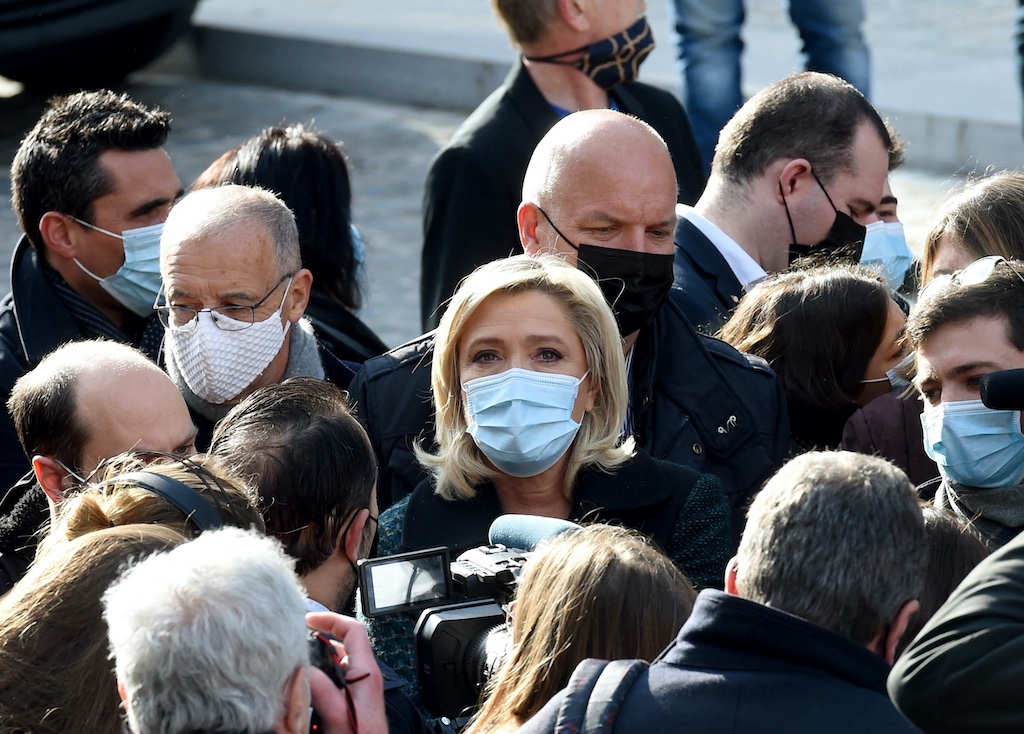
Marine Le Pen, leader of the far-right party Rassemblement National, answers journalists’ questions in Avesnes-sur-Helpe on April 9, 2021. (FRANCOIS LO PRESTI/AFP via Getty Images)
A year ahead of France’s 2022 presidential election, countless articles have been written about the threat posed by the far-right candidate Marine Le Pen, leader of the Rassemblement National. With no particular attention paid to the French system or the current context, we are often told that she is the main contender to the presidency and the embattled Emmanuel Macron’s only real opponent. As always, opinion polls are mustered to frpush the message that this is what the people want. That it is not yet clear who the candidates will actually be — and whether a unified left-wing alternative could arise — does not seem to bother anyone with access to public discourse. The dice have already been rolled, and they seem loaded anyway.
This “populist hype” is not limited to the French setting. It’s common to see the media circus get excited ahead of any election if the far right is predicted to perform well, and move on quickly if it doesn’t, ignoring meanwhile anything that would be of value to our democratic debate. Who here remembers anything from the 2017 presidential election beyond the second round, setting Macron against Le Pen? Why care that radical left Jean-Luc Mélenchon was within reach of Le Pen, and that if Socialist Benoît Hamon had stepped down, even a small share of his 2.2 million votes would have been enough for Mélenchon to reach the second round instead, leaving Le Pen stranded?
This is nothing new; the exact same thing happened when Marine Le Pen’s father reached the second round in 2002. Back then, we were told this was an “earthquake” and the Republic was in danger, even though Le Pen’s share of the vote had been stagnating since 1988. It was only thanks to how incredibly unpopular the main governing parties in France had become — leading to record levels of abstention — that the far-right leader got through to the second round. Yet all that was discussed was that fascism was at the gates and the only way to prevent it was to vote for the same old despised status quo. From then on, the cure to the far right was to tap into its discourse and program — if you can’t beat them, join them, right? No one seemed to care that nine out of ten French voters had never voted for the Front National or that the vast majority considered it a threat to democracy.