With Putin’s Ukraine Incursion, Hawks in Washington Got Exactly What They Wanted
The latest escalation in the Ukraine crisis requires us to hold two ideas at the same time: that Vladimir Putin bears much responsibility for the immediate crisis, and that the long-standing US refusal to accept limits to NATO expansion helped bring it about.
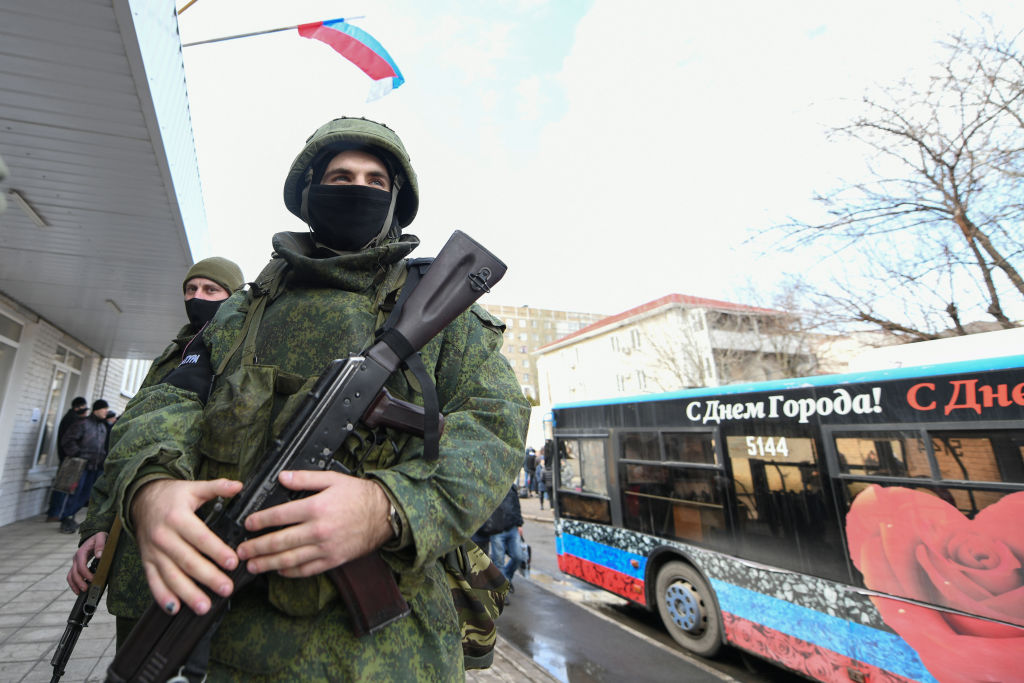
People arrive at a recruiting office to register themselves after declaration of mobilization in the Donetsk region under the control of pro-Russian separatists, on February 23, 2022. (Stringer / Anadolu Agency via Getty Images)
This week saw the most dramatic escalation of the slow-burning Ukraine crisis yet, as Russian president Vladimir Putin formally recognized the independence of the country’s breakaway eastern regions of Donetsk and Luhansk, and sent Russian troops into the area, supposedly for peacekeeping purposes.
The first thing to say about this is that it’s reckless and illegal. Under the Minsk accords that both Russia and the West have been pushing for years as a settlement to the mini–civil war that’s been roiling eastern Ukraine the past eight years, these regions were meant to gain autonomy while staying part of Ukraine. Putin’s move effectively rips that agreement up.
Second, under international law, there are processes in place for carrying out peacekeeping missions; unilaterally sending troops into a neighboring country with which you’re feuding is not it. This is why Kenya’s UN representative, who had abstained from voting to discuss Russia’s actions earlier this month, said yesterday the move “breaches the territorial integrity of Ukraine,” comparing it to the way African countries’ borders had been drawn and redrawn by dying empires. The “rules-based international order” may have its problems and be selectively invoked, but at its core it is a fundamentally good principle: that the strong cannot simply do whatever they want to the weak.