Jean-Paul Sartre Took a Stand Against Empire
Jean-Paul Sartre came to prominence just as France was trying to cling onto its empire in a series of bloody wars. He used his platform as a public intellectual to speak out bravely against colonial repression, risking his own life in the process.
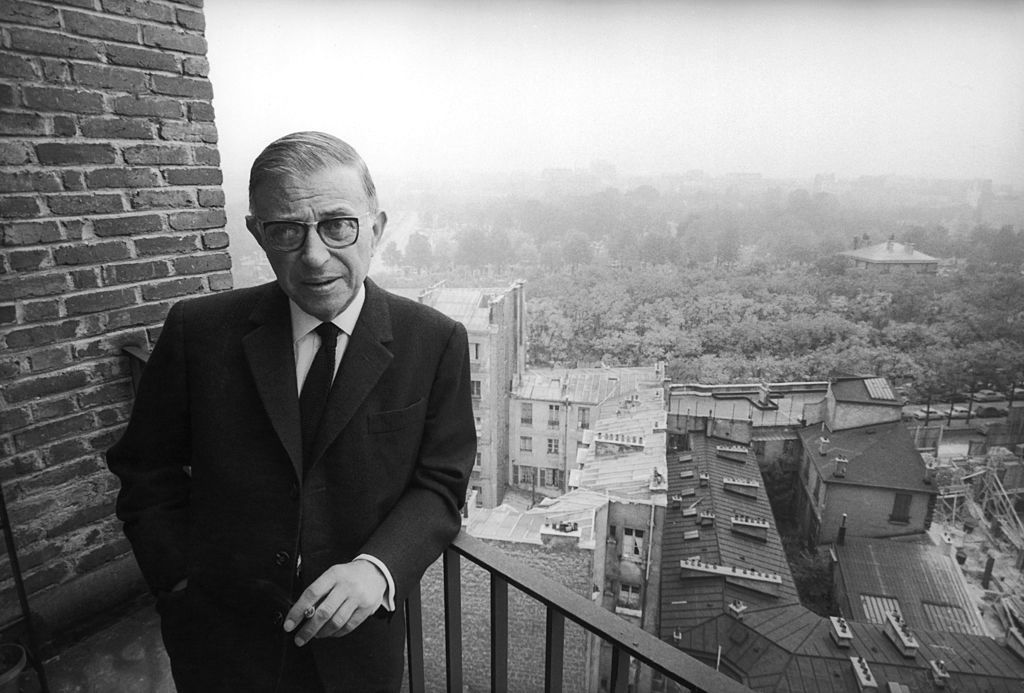
Jean-Paul Sartre in Paris, France, 1966. (Photo by Dominique Berretty / Gamma-Rapho via Getty Images)
French public life today is bitterly hostile to anti-colonial politics. Figures like Pascal Bruckner and Bernard-Henri Lévy have long denounced opposition to US wars in the Middle East and support for the Palestinians as a manifestation of “Islamo-leftism” and treachery to Western civilization. With an eye to next year’s presidential election, Emmanuel Macron’s government has taken up the cry, alleging that “Islamo-leftism” has taken hold in French universities and promising to clamp down.
Macron himself has linked terrorist attacks on French soil to “postcolonial or anti-colonial discourse” that supposedly encourages Muslims to separate themselves from mainstream society. According to Macron, that discourse is a US import. But figures like Bruckner and Lévy — collectively referred to as the “new philosophers,” although they have been on the scene since the 1970s — would also blame an earlier generation of French radical thinkers.
Jean-Paul Sartre ranks highly in their catalogue of villains. In his own time, Sartre was one of the world’s most celebrated and influential public intellectuals. Since his death, however, Sartre’s critics have presented him as an apologist for totalitarianism and contrasted him unfavorably with contemporaries such as Albert Camus and Raymond Aron. They dismiss his writings on colonialism as naïve at best, malign at worst, and certainly lacking in relevance for today’s conditions.