Outlaw Ned Kelly Left Behind a Manifesto for the Ages
Ned Kelly is Australia’s most famous and beloved outlaw. He didn’t only defy the colonial police, he also left behind a revolutionary manifesto decrying oppression and poverty that demands to be read.
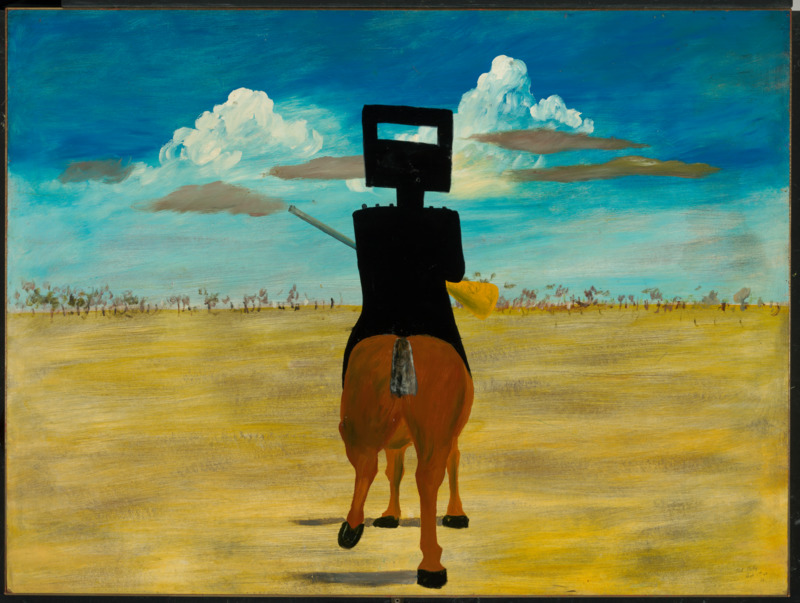
Nolan, Sidney, Ned Kelly, 1946, enamel paint on composition board. Melbourne, Australia. (National Gallery of Australia)
At 10:00 on the morning of November 11, 1880, Ned Kelly hanged from a rope until dead. His last words were “Such is life.” By some accounts, however, a journalist working to a tight word limit distilled this phrase from “Ah well, I suppose it has come to this.” Whatever the case, the laconic fatalism of Ned Kelly’s apocryphal final refrain resonated. He is Australia’s most loved bushranger, and his words and image are emblazoned on bumper stickers, stubby holders, and tattooed chests across the breadth of the nation.
Well before his young death behind the cold bluestone walls of the Old Melbourne Gaol, Kelly had begun cultivating a legend. And whenever Kelly supporters have found reality wanting, they haven’t hesitated to add to it — sometimes movingly, sometimes comically.
In 1995, for example, in the midst of growing republican sentiment, Ned Kelly historian Ian Jones published Ned Kelly: A Short Life. Then–Labor prime minister Paul Keating was a fan. Like many before him, Keating became thoroughly convinced that at his last stand, under his homemade armor, Ned Kelly carried a declaration of independence for the Republic of North-Eastern Victoria.