Australia, a Counterrevolutionary Colony
With the British settlement of Australia, Europe’s long history of overseas convict transportation entered one of its most bizarre chapters, as an entire continent was excised as an open-air prison for England’s criminalized lower classes.
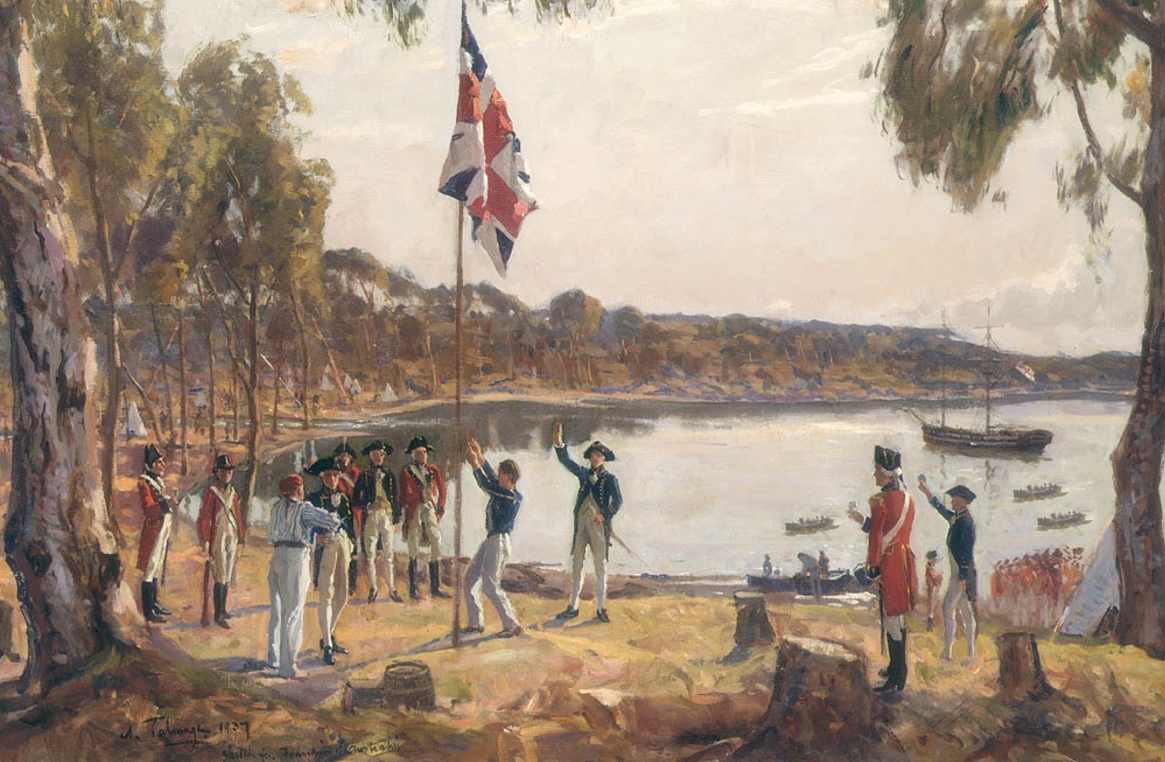
On November 24, 1792, in the midst of the French Revolution, the curtains rose on a new play in Paris. A motley collection of French princes, barons, priests, and bankers stumbled across the stage, exiles in “an uncultivated country” in the distant south. These remnants of the French upper class had been escorted from “a ship at anchor” by revolutionary “French volunteers.” The local indigenous people, led by a “Chief Oziambo,” joined the volunteers in raising an obelisk to commemorate the occasion.
This play, Les Emigres aux Terres Australes (The Emigrants to the Southern Lands), was the first to be set in colonial Australia. The subtitle was Le Dernier Chapitre d’une Grande Révolution, Comedie (The Last Chapter of a Great Revolution, a Comedy). The playwright, a certain Citizen Gamas, had reimagined the invasion of Australia and flipped it upside down. In place of the English sending their criminalized lower classes to the Antipodes, the French had sent their aristocrats — a tongue-in-cheek alternative to the guillotine.
If Gamas’s satirical inversion was revolutionary, then by implication, Britain’s colonization of the Australian continent was counterrevolutionary. Eric Hobsbawm describes this era as the first global Age of Revolution: in France Louis XVI would be beheaded within two months, in the Caribbean the Black Jacobins of Saint-Domingue had risen up in revolt, and from Connecticut to Cuzco the peoples of the Americas were challenging the divine right of monarchs to rule.