The Soviets Who Wanted Fashion for All
In the years after the revolution, Russian designers rethought style. Among them was Varvara Stepanova, who aimed to take fashion out of the realm of luxury and make it accessible to all.
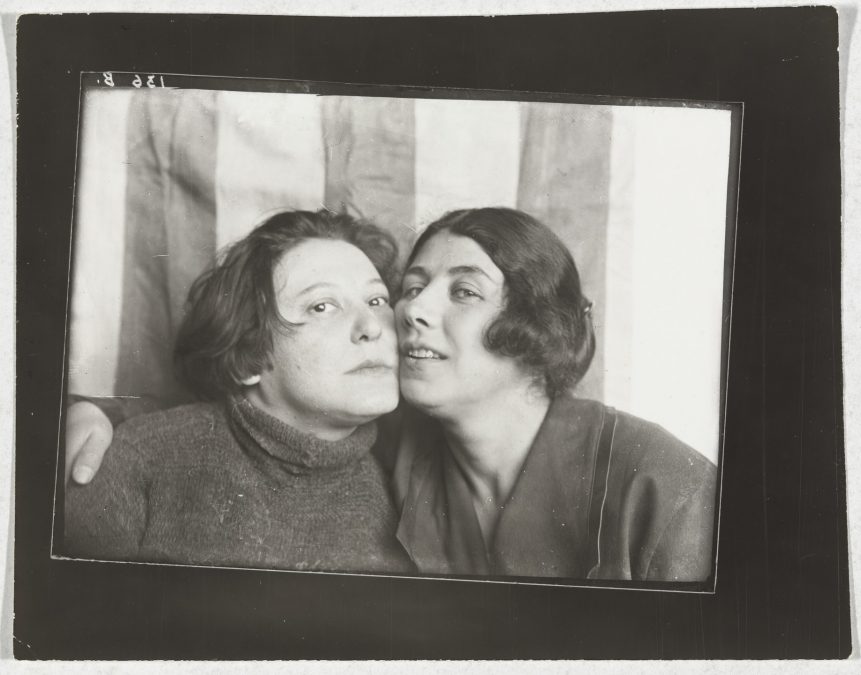
Varvara Stepanova and Liubov Popova, photographed by Alexander Rodchenko in 1924.
In the autumn of 1923, as Vladimir Lenin shadowed the newly formed Soviet Union from his deathbed, one of Moscow’s largest factories became the domain of two artists determined to seize style for the people.
The experiment had a trace of desperation. After Russia’s imperial regime collapsed at the climax of World War I, its political factions started fighting each other instead, until the Red Army finally defeated an unlovely collection of monarchists, landowners, and generals auditioning for Supreme Leader. Millions of Russians were killed or starved; industrial output fell to a fraction of its prewar level.
Few things could still go wrong at the First State Cotton-Printing Factory, to use its postrevolutionary title. But the facility’s director did not invite Liubov Popova and Varvara Stepanova, a wealthy painter and a working-class one, to come there shrugging haplessly. He believed in their movement, which argued that Soviet artists had to reimagine the commodities of everyday life — to collectivize the economy of desire. The workers deserved both bread and satin.