How a Revolution on the Tiny Island of Grenada Shook the World
On this day in 1979, the most remarkable social revolution in the modern history of the Anglophone Caribbean began. Today, we remember not only the crisis and imperialist invasion that brought the Grenadian Revolution to an end, but its tremendous accomplishments.
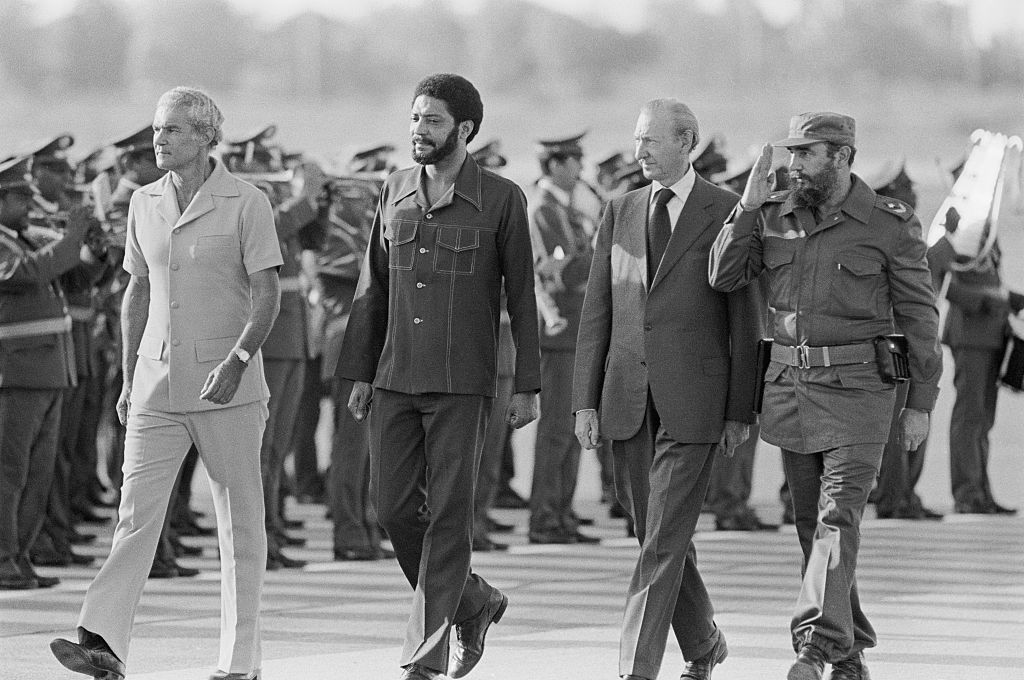
Maurice Bishop, prime minister of Grenada (second from L), walks with (L-R) Michael Manley, prime minister of Jamaica; Kurt Waldheim, secretary-general of the United Nations; and Cuban president Fidel Castro, during arrival ceremonies in Cuba on September 2, 1979, for the Non-Aligned Countries Summit. (Bettman via Getty)
I left Grenada in late September 1983, to begin work on my thesis on the living Grenada Revolution as a PhD student at the University of the West Indies at Mona, fully intent on returning to do further research the following year and without any forewarning of the disaster that would occur in the coming weeks. I come therefore with the perspective and biases of someone who lived and worked in the Revolution in its final days.
In spite of new and refreshing writing in recent years, there is, nevertheless, a certain established and encrusted narrative structure of the Revolution which goes something like this: Power was taken from Eric Gairy in 1979; four and a half years intervene; then there is a leadership crisis which we need to understand and apportion blame; the crisis itself is explanatory of the revolution. We can therefore assign blame and come to one of two conclusions: either avoid in the future the ideology, tactics, or even the very people who were guilty of despoiling the process, or, conversely, avoid revolution altogether, for the proof that Saturn always devours his children is evident once again in the Grenadian instance.
There is, of course, nothing inherently wrong in trying to understand the origins and course of the 1983 crisis. This is necessary and much of my own work on Grenada has tried, agonizingly, to walk and re-walk those moments to try to grasp what went wrong. Yet, this exercise inevitably obscures the day-to-day reality of some four and a half years — more than 1,670 days of the most remarkable social experiment in the Anglophone Caribbean since emancipation in 1838. My argument is straightforward: It is that lost in the detritus of the 1983 tragedy, there were initiatives taken that went beyond any experiment tried anywhere in the history of the Anglophone Caribbean. And that if in the future, we are to rethink and rebuild a Caribbean that is more in the interest of the people, we must learn not only from what the Grenada Revolution did wrong but also what it did right.