Why “Pro-Worker Conservatives” Misrepresent Viktor Orbán’s Hungary
Figures like Tucker Carlson have hailed Hungarian premier Viktor Orbán for marrying cultural conservatism with protectionist economic measures. Yet for all his demagogic attacks on finance, Orbán's policies have favored local oligarchs and sharply increased social inequality — pointing to the hollowness of his American fans' own "pro-worker conservatism."
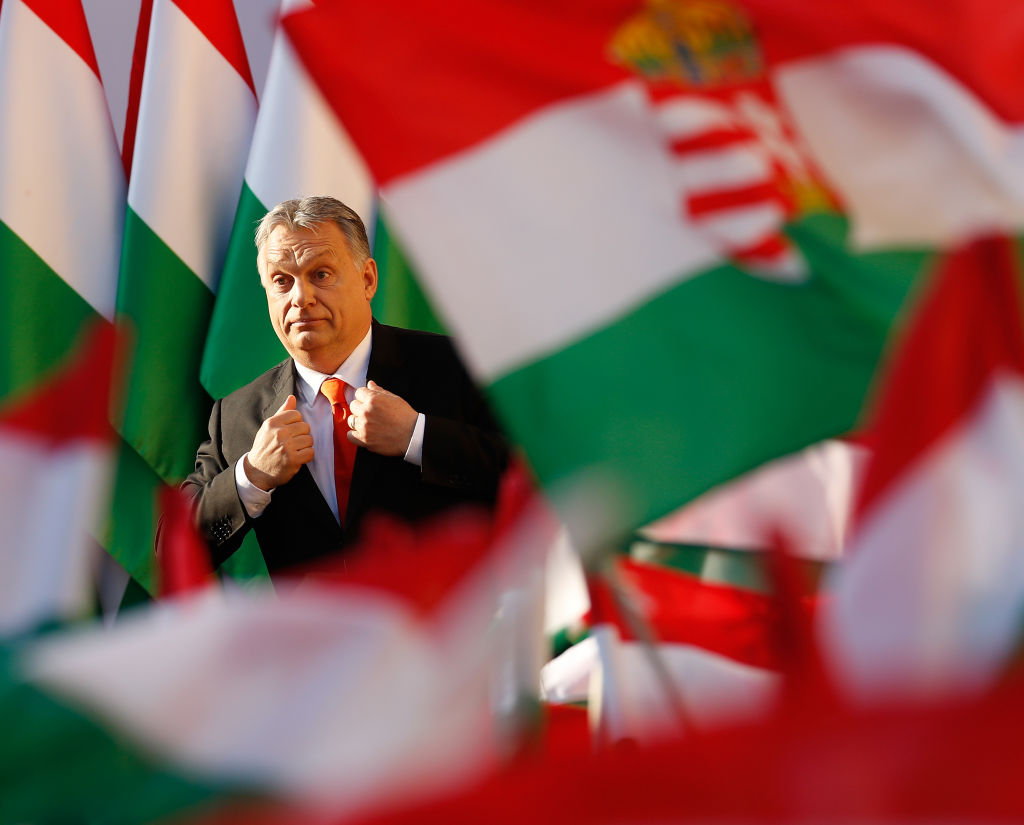
Hungarian prime minister Viktor Orban attends his Fidesz party campaign closing rally on April 6, 2018. (Laszlo Balogh / Getty)
On December 10, 2020, Gladden Pappin, professor of political theory at the Catholic-affiliated University of Dallas, tweeted about his meeting with Hungarian families minister Katalin Novák. Pappin’s tweet praised Hungary’s family policies, aimed at reversing demographic decline in a country with birth rates among the lowest in Europe. Minister Novák also happens to be the vice-chair of prime minister Viktor Orbán’s Fidesz party. Pappin’s enthusiasm might seem unusual at first glance. After all, in his three consecutive terms since 2010, Orbán has more often made headlines by putting the small post-socialist country at the forefront of the global radical right than on account of his economic policies.
The same week, the Texas Monthly ran a piece on Pappin, characterizing him as a proponent of reshaping the Republican Party to become more accommodating of working-class demands and public spending. Outside the classroom, Pappin is also the deputy editor of American Affairs, a journal known for its call for the US right to mount an “economic populist” turn with more industrial policy, employee protections, and higher taxes.
Pappin is not the only American Affairs editor to have recently expressed fascination for Orbán’s Hungary. Around the time of his visit to that country, editor in chief Julius Krein appeared on a panel hosted by Budapest’s Mathias Corvinus Collegium, a government-funded educational institution and think tank. In his talk, Krein praised the Hungarian right for not falling for the Reaganite small-state libertarianism that he saw as the biggest obstacle to introducing “economic populist” policies under Donald Trump.