The Organizers of the Bolivian Coup Will Never Accept Free Elections
Almost a year since the military coup against Evo Morales, today Bolivians will finally get to vote on a new president. But the forces that overthrew Morales have done everything they can to stop his Movement Toward Socialism to return to power through a free and fair election.
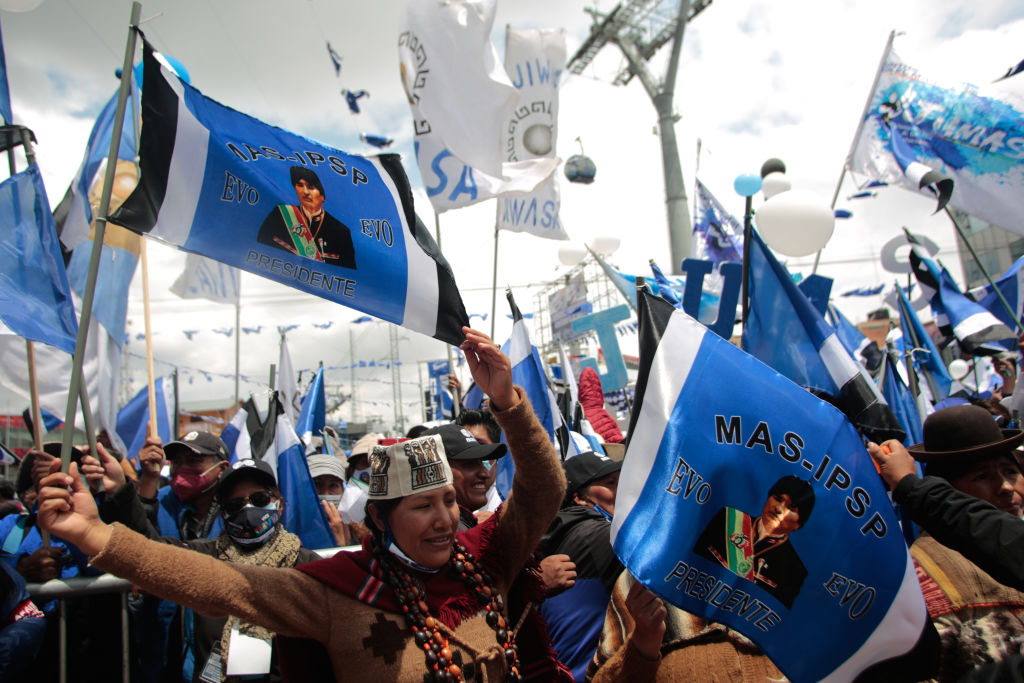
Demonstrators in El Alto, Bolivia hold flags with the face of former president Evo Morales during a MAS closing rally ahead of the presidential elections taking place on October 18, 2020. (Gaston Brito Miserocchi / Getty Images)
As Bolivia votes on October 18 — in an election delayed three times by Jeanine Áñez’s de facto government — ousted president Evo Morales’s Movement Toward Socialism (MAS) enjoys a strong poll lead. While Áñez’s own decision to pull out of the race has strengthened likely second-place finisher Carlos Mesa, every single opinion poll has pointed to MAS’s candidate, Luis Arce Catacora, either winning the presidency in the first round or, at the very least, obtaining a plurality of votes.
To win in the first round and avoid a run-off vote, the top candidate would need 40 percent support plus a ten-point lead. In recent days, private media channel UNITEL broadcast a Ciesmori poll showing MAS’s Arce would fall just short of this — taking 42.2 percent, followed by Mesa on 33.1 percent and the far-right Luis Fernando Camacho on 16.7 percent. It also forecast that MAS would obtain a majority in six out of nine regions, while Santa Cruz would go to Camacho and the Tarija and Chuquisaca regions to Mesa. Tu Voto Cuenta predicted a similar result, but CELAG forecast that Arce will take 44.4 percent, giving him a more than ten-point lead over Mesa on 34 percent.
Such surveys may not be entirely reliable — pollsters have traditionally ignored the extent to which rural areas and the large Bolivian communities abroad, particularly in Argentina and Brazil, support MAS. This would imply that the final vote for MAS under normal circumstances and in a fair election may be closer to the 47 percent obtained by Morales last October — or even higher given the widespread unpopularity of the neoliberal measures implemented by the Áñez regime over the last year, as opposed to Arce’s image as the chief architect of fourteen years of economic growth and political stability.