The 1776 Unites Project Is an Exercise in Empty Capitalist Boosterism
Last week, Donald Trump denounced the “radical” ideas brainwashing students to hate America. Right on time, the 1776 Unites project released education materials they claim are a corrective. Praised by education secretary Betsy DeVos as "wonderful," the materials aren't a serious look at American history — they’re empty boosterism for American free markets.
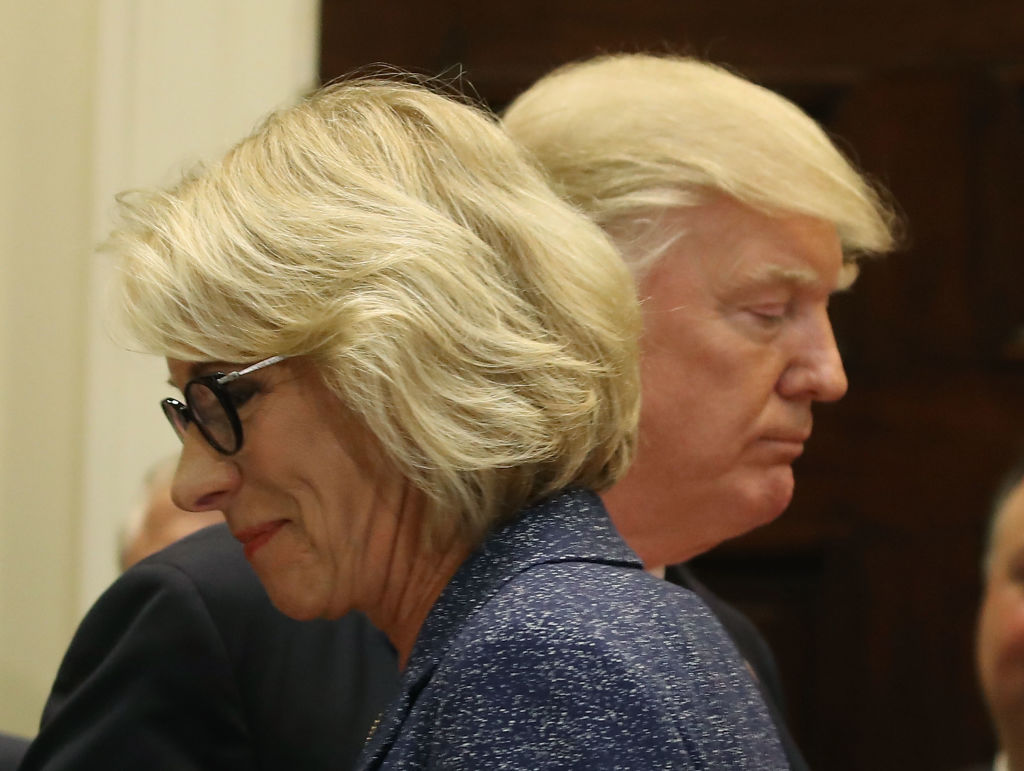
President Donald Trump stands with Education Secretary Betsy DeVos in Washington, DC, 2017. (Mark Wilson / Getty Images)
On September 17, 2020, President Donald Trump announced he was creating a presidential commission to encourage “patriotic education” named the 1776 Commission. At the same time, across town, education secretary Betsy DeVos heaped praise on a new curriculum developed by conservative think tanks to counter what Trump termed the “twisted web of lies” spread by radicals that “America is a wicked and racist nation.” Earlier this summer, Arkansas senator Tom Cotton announced he was introducing legislation, the Saving American History Act of 2020, that would defund school districts that used the New York Times’ 1619 Project, an essay series that foregrounded the history of slavery and racism in US history.
While the specifics of what the president’s 1776 Commission will consist of have yet to be announced, the commission DeVos praises as “wonderful” — also named for the year of American independence — debuted this week, seemingly in coordination with Trump and DeVos’s culture war speeches. Contributors to 1776 Unites are open that they see the problem with emphasizing the history of slavery and racism as promoting a culture of “victimization” and giving permission to children to blame their failures on racism and capitalism. As one contributor, Dean Nelson, concluded, “We also must avoid rearing kids who see every setback they face through the lens of race and look for opportunities to be offended or outraged.”
According to the 1776 Unites project, the corrective to liberal histories of victimhood is teaching children that America is a land of opportunity, even in spite of the hiccups of its racist past, and that everyone can achieve wealth through hard work and self-uplift. Project essayist John Sibley Butler calls for more historical attention to the “Black Bourgeoisie” and characterizes the 1619 Project as ignoring “the history of my tradition and presents blacks as going from slavery to poverty, with no role models.” Emeritus professor of finance from the University of Tennessee Harold A. Black puts his finger on the real irritant that motivates these conservatives: “It was the War on Poverty’s resultant destruction of the black family that derailed our progress.”