Turning the Pink Tide Green
Left governments in Latin America have successfully nationalized much of the mining sector, reclaiming foreign profits for social spending. The next step is to get beyond extraction altogether, taking cues from indigenous movements that have long been fighting for a green future.
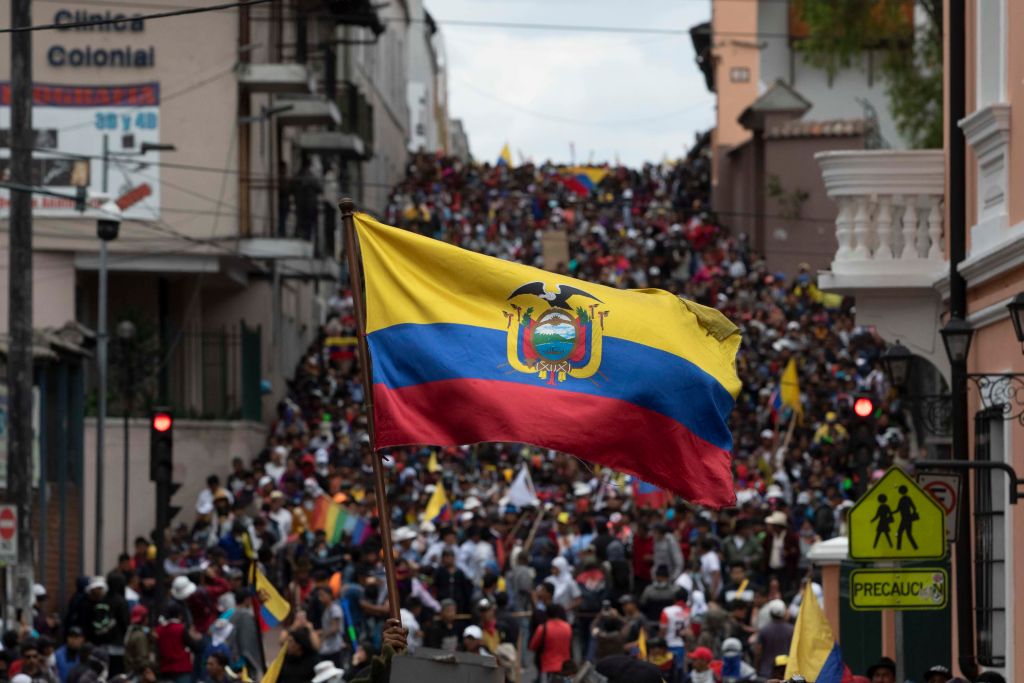
A demonstrator waves a flag near the Presidential Palace of Carondelet in Ecuador. (Photo by Jorge Ivan Castaneira Jaramillo / Getty Images)
In her book Resource Radicals, political scientist Thea Riofrancos traces the conflict between social movements and the self-styled, post-neoliberal administration of Rafael Correa in Ecuador. Her analysis centers on the polarization within the Left over “extractivism,” understood as an economic development model based on the hyper-exploitation of natural resources for export, usually by foreign firms, during Latin America’s so-called Pink Tide.
Riofrancos counters state-centered narratives to explore the role of movements in shaping state action. She emphasizes the materiality of discourse — language’s capacity to “shape the world” — and its dynamic, contested, and collective nature. In so doing, she points to the power of movements to both strategically wield and transcend the institutions of liberal democracy.
As Riofrancos and Daniel Aldana Cohen note in their introduction to NACLA’s recent issue on climate justice in the Americas, the US left has much to learn from its comrades to the south. To that end, this new work offers a timely analysis of the dilemmas of leftist governance, the relationship between movements (the “Left-in-resistance”) and the state (or the “Left-in-power”), and the challenging road to a future beyond the oppressive paradigms of capitalist development that have dominated our societies since conquest.