The Iraq War Is the Skeleton Key
George W. Bush’s war on Iraq is central to understanding our world today. Yet the war has largely been flushed down the memory hole. Remembering how we came to start the war and who sold us it is critical to stopping us from being dragged into similar bloody conflicts in the future.
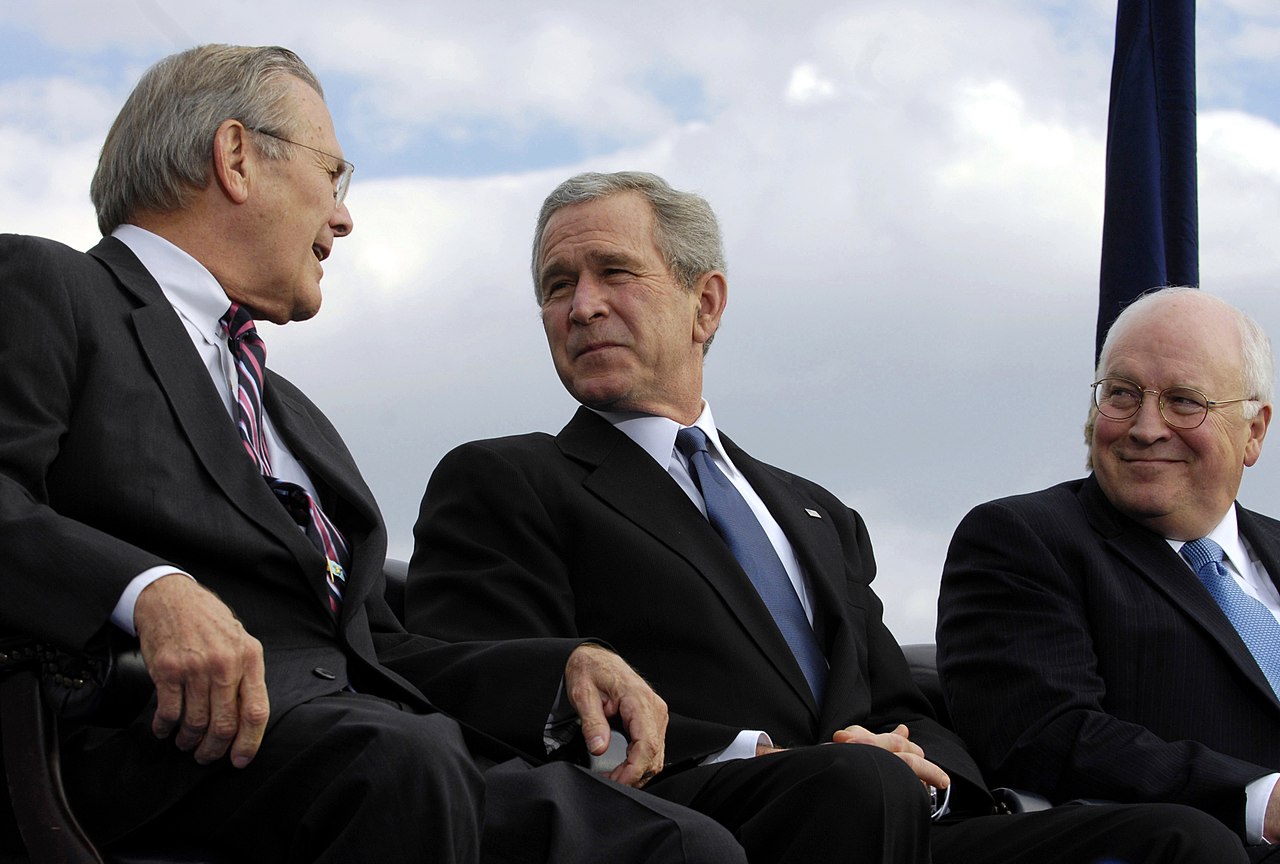
Secretary of Defense Donald Rumsfeld shares a laugh with President George W. Bush and Vice President Dick Cheney during his farewell parade at the Pentagon in December 2006.
When, at the end of May, President Donald Trump threatened to gun down looters in the streets of Minneapolis, some heard echoes of Paul Bremer. The top civilian administrator presiding over the occupation of Iraq from May 2003 to June 2004, Bremer is usually remembered for his decisions to disband the country’s military and fire countless state employees under the imperatives of de-Baathification. Because the viceroy’s reckless policies kicked off an insurgency, it’s often forgotten that the George W. Bush administration dispatched him to restore law and order to the Middle East. Upon arriving, he sought to build a muscular Iraqi police force in collaboration with former New York Police Department commissioner Bernie Kerik. Bremer also tried to change the military’s rules of engagement to allow American soldiers to fire on looters drifting through Baghdad’s debris-peppered streets.
Read against current events, anecdotes of Bremer’s first days in Iraq bring to mind Stuart Schrader’s observation that “the history of US empire is the history of policing experts teaching indigenous cops how to patrol and investigate like Americans . . . But the flow is not one-way: these institutions also return home transformed.” The crises of the past few years reveal that this dialectic extends beyond law enforcement to encompass the entire metropole. The Pentagon’s growing transfers of military surplus left over from the Iraq War to police departments correlate with a coarsening of the United States’ political culture. And it is with an eye toward this broader embrace of brutality and impunity that Brendan James argues that the Iraq War is “a skeleton key for where we are now.”
James and Noah Kulwin are the creators and cohosts of a new podcast on the war and the pathologies that emerged in its wake, aptly titled Blowback. Over the course of ten episodes, the two sketch out what they describe as a “counter-history” of America’s forays into Iraq. Listeners working their way through the series will hear clips from CNN and MSNBC broadcasts, and anecdotes drawn from the reportage of mainstream journalists, like George Packer and Bob Woodward. What emerges from the synthesis constructed by the hosts is a criticism of these conventional secondary sources. James and Kulwin paint a portrait of a deluded and venal elite convinced that the exercise of American power today will solve the problems created by the exercise of American power in the past.