When Harlem Renaissance Novelist Claude McKay Decamped for the Port of Marseille
Struggling for cash in the late 1920s, Harlem Renaissance trailblazer Claude McKay found casual work as a docker in Marseille. Finally published this year, his Romance in Marseille illuminates the city with both personal emotion and a vivid class feeling — testament to the tough fight for solidarity among the migrant proletariat.
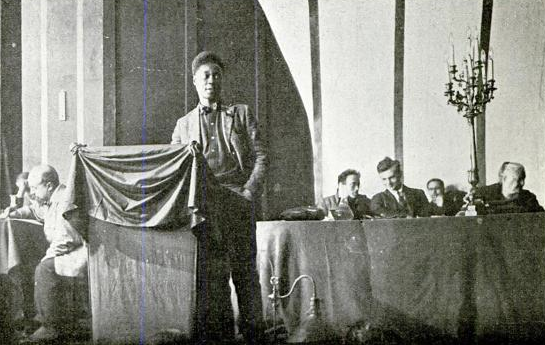
Claude McKay speaking at the Kremlin in Moscow.
In the opening passages of Little Dorrit, Charles Dickens describes how “Hindoos, Russians, Chinese, Spaniards, Portuguese, Englishmen, Frenchmen, Genoese, Neapolitans, Venetians, Greeks, Turks, descendants from all the builders of Babel, come to trade at Marseilles, sought the shade alike — taking refuge in any hiding-place from a sea too intensely blue to be looked at.” Indeed, ever since Alexandre Dumas published The Count of Monte Cristo in 1844, Marseille has occupied a special place in the literary imagination. In Wicked City, a cultural portrait of Marseille published last year, the late Nicholas Hewitt said France’s second city is best seen “as a reflection of the shifting preoccupations of the observer.”
We see this also in the writings of Claude McKay focused on Marseille. Having found casual work as a docker in the city while struggling for cash in the late 1920s, McKay wrote Banjo, subtitled “A Story Without a Plot” — a tale of a group of black migrants living hand-to-mouth in the city’s Vieux Port district. The title character takes his pseudonym from the instrument he plays and loves. But his full name, Lincoln Agrippa Daily, reflects the novel’s dual focus on both the humdrum joys and struggles of lumpenproletarian life on the one hand, and existential questions of identity, oppression, and liberation on the other.
It is testament to the range of McKay’s “shifting preoccupations” that his Romance in Marseille, finally published in 2020, can add as much as it does to a tapestry that is already so rich. He began work on this manuscript just months after the publication of Banjo, and it was initially comprised of unused material from the novel. Finally seeing the light of day ninety years later, it remains a recognizable portrait of precarious living — and an experiment in the ability of literature to effect change.