How South Korea’s Pro-Democracy Movement Fought to Ban “Murderous Tear Gas”
In 1980s South Korea, hundreds of protesters were maimed and blinded by tear gas grenades fired by police. But the demand to stop the state’s use of tear gas soon itself became the focus of protests — a fight against police brutality which rallied millions of South Koreans behind the pro-democracy movement.
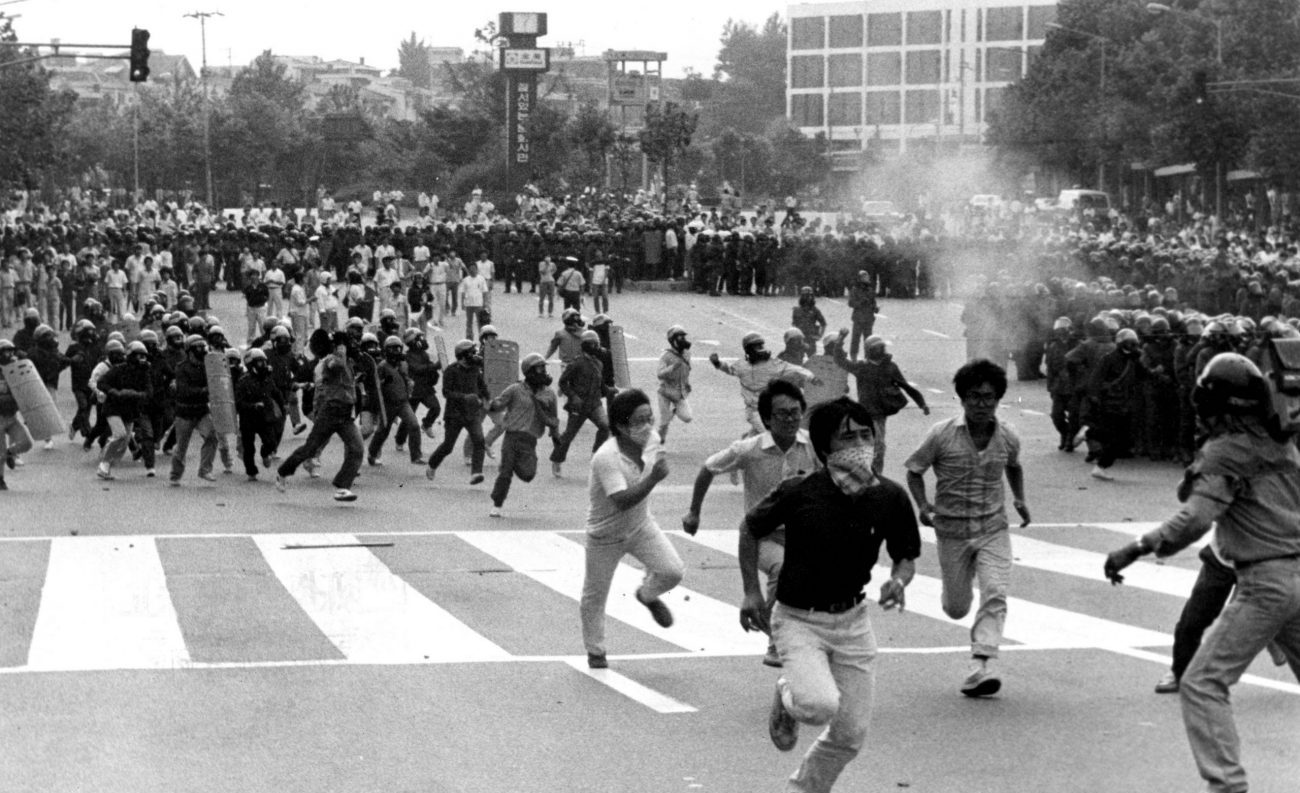
Police fire tear gas on South Korean protesters in 1987. Imgur
A stinging feeling in the eyes was a fact of everyday life in the cities of 1980s South Korea. As the repressed details of the 1980 Gwangju massacre began to reach public attention, clashes between Molotov cocktail-wielding demonstrators and riot cops became part of the urban scenery. Students fought police in battles over the regime’s ties to the United States, workers’ rights, and the suppression of democracy itself.
For military dictator Chun Doo-hwan, the fear was that such a heightened atmosphere of tension might jeopardize Seoul’s status as host city for the 1988 Olympic Games — and put up barriers to his liberalization of South Korea’s developmental state structure. Seeking to quell the unrest in the streets, he ordered riot police to deploy increasing volumes of one of their key weapons, tear gas.
The situation came to a head in June 1987, as a coalition of Christian associations, civil organizations, and student activists known as the National Council for the Democratic Constitution called for massive street protests demanding constitutional reform and the removal of the military dictatorship. During this month alone, over 670,000 canisters of tear gas were fired at demonstrators — more than all the tear gas fired between 1980 and 1985.