Hopeful Altruism Is No Substitute for Radical Politics
Rutger Bregman made a name for himself by dressing down Tucker Carlson and calling out the ultrarich at Davos. But his new book is closer to a hopeful self-help guide than a manifesto for radical political change.
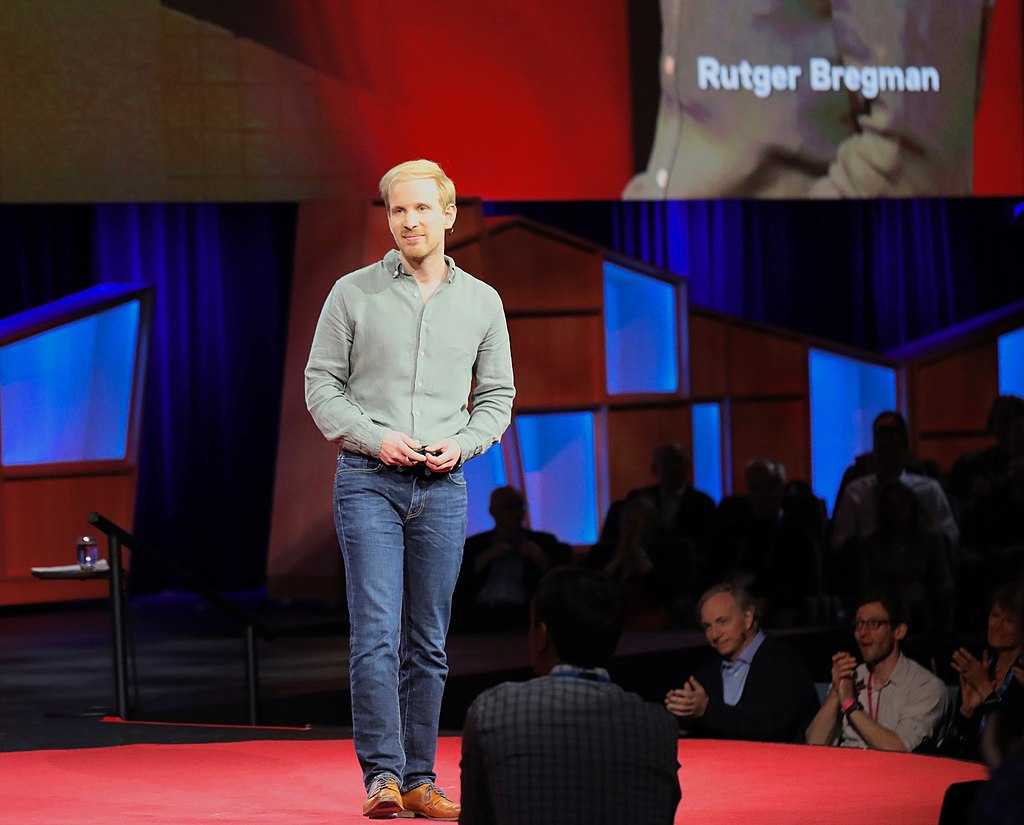
Rutger Bregman gives a TED talk, April 25, 2017.Steve Jurvetson / Wikimedia
Rutger Bregman is one of the most prolific intellectuals of our age. His books are on display at airports from Frankfurt to Shanghai. In December 2018, Australian media magnate Rupert Murdoch was photographed at a Caribbean beach with Bregman’s Utopia for Realists in his hands. Trevor Noah knows “Rutger” by name. Two Davoses ago, we saw Bregman in a panel at the Swiss forum talking on the subject of taxation. “Taxes!” he proclaimed, “that’s what we need to talk about! I feel like a firefighter at a conference on fire extinguishing techniques who is not allowed to pronounce the word ‘water.’ Taxes, we need to talk about taxes!”
Bregman’s statement ended up on Twitter, views skyrocketed and suddenly the Dutch thought leader found himself trolling conservatives on Fox News, so angering Tucker Carlson that the latter refused to air an interview with him (it was packed with expletives). “The Dutch historian who savaged the Davos elite,” the Guardian’s headline ran a couple of days later.
Bregman indeed has a penchant for political grenade-throwing. Starting with his 2017 Utopia for Realists — preceded by a flurry of publications in Dutch — the Dutchman has morphed into something of an intellectual superstar, planting conceptual seed bombs which blossom into further debates in Dutch and English, from basic income, the idea of progress (Geschiedenis van de vooruitgang), or our received notions of inequality (Waarom vuilnismannen meer verdienen dan bankiers).