Emmanuel Macron’s Shock Doctrine
For years, Emmanuel Macron has worked to get rid of the 35-hour workweek and worker protections from unfair dismissal. Today, his government is using the coronavirus lockdown as a pretext to push ahead with this agenda — and allow bosses to unilaterally undermine labor conditions.
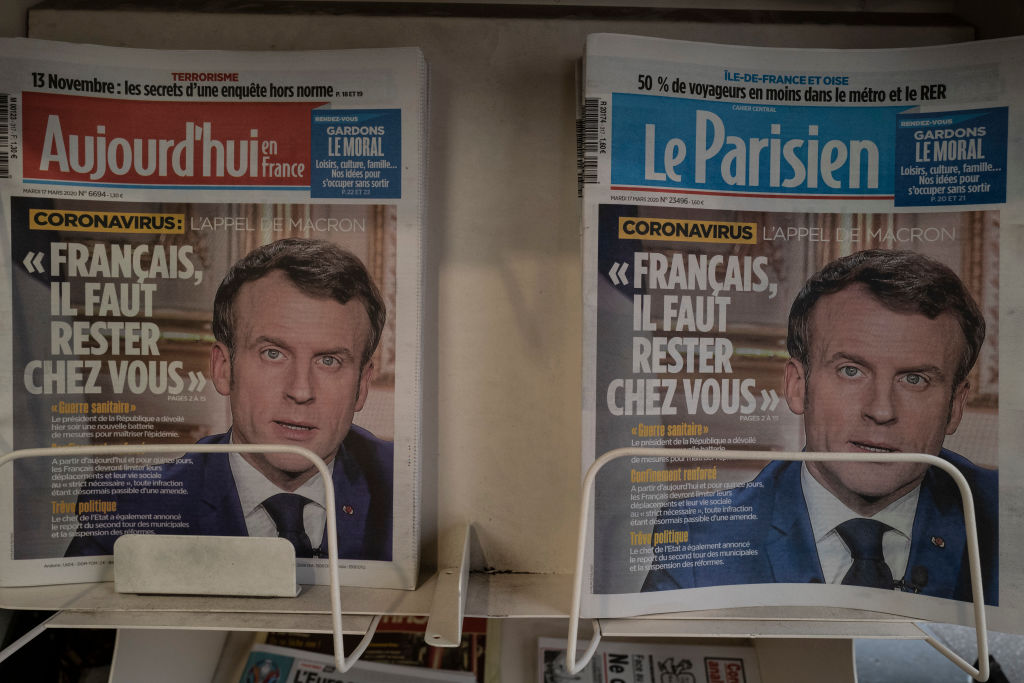
French president Emmanuel Macron appears on the front of newspapers with the words “Stay home” on March 17, 2020 in Paris, France. Veronique de Viguerie / Getty
Last Monday evening, France’s president, Emmanuel Macron, gave a thirty-minute televised address on the public health emergency caused by COVID-19’s arrival on French soil. “We are at war,” Macron declared solemnly, a declaration he was to repeat a further five times in the course of his speech. The nation was exhorted to present a united front against the viral enemy and to show civic-mindedness in confinement. But the moralizing, patriotic discourse deployed by the government — amplified by many commentators — occludes the reality of a crisis exacerbated by decades of conscious policy decisions.
Less than a week after this address, on Sunday, the French parliament passed into law the emergency measures declared by Macron, including powers for employers to alter working conditions unilaterally and a general restriction of civil liberties. This package of measures reinforces and extends policies that governments had been implementing well before this epidemic — indeed, ever since François Hollande’s presidency. There’s no question that some emergency measures are necessary. But what we’re witnessing at the moment seems closer to an opportunistic instrumentalization of the health crisis to intensify police impunity and the deregulation of labor.
The gravity of the present crisis is the price France is paying for recent sustained attacks on the public sector — and on the health service in particular. Already in October 2017, hospital doctors, who rarely go on strike, took industrial action to denounce the terrible working conditions in the health sector (frozen pay, widespread psychosocial problems, burnout, understaffing). Macron had been elected that spring, hinting that he would ensure better conditions in hospitals, but these improvements never materialized. Instead, in 2019, paramedical emergency workers went on strike as hospitals continued to be underfunded and medical staff collapsed from overwork: in response, military police requisitioned health workers by night to force them to work.