Clare Boothe Luce, From Broadway to the Cold War
Author of Broadway hit The Women, the Vanity Fair managing editor Clare Boothe Luce was a dogged anticommunist. As US ambassador to Italy, she worked tirelessly to keep the Left out of office — and set a precedent for Washington’s meddling in democracies abroad.
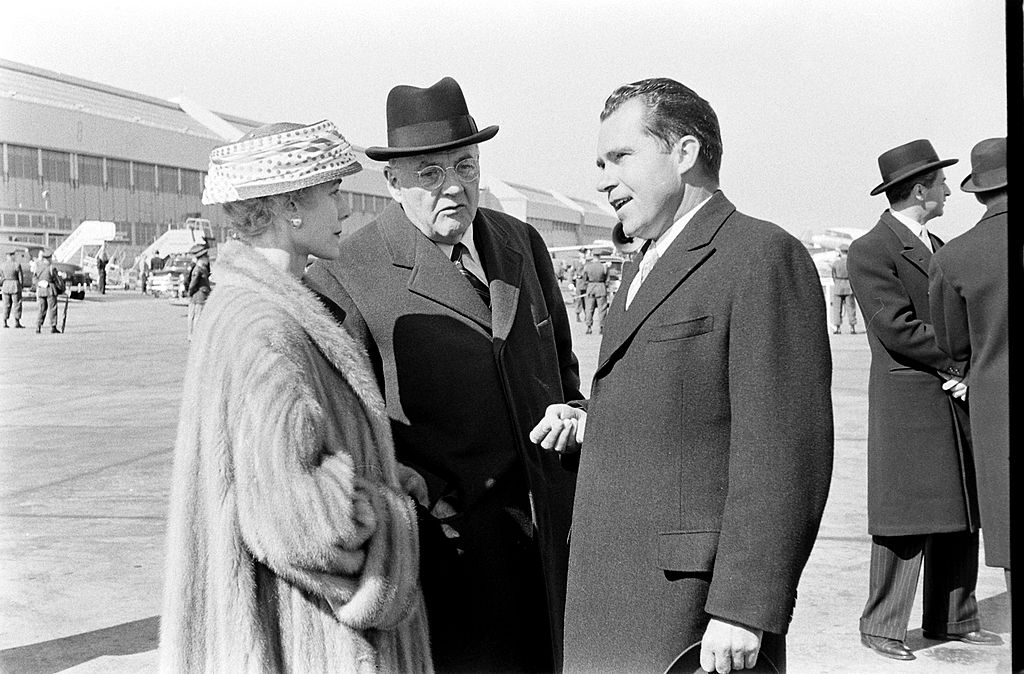
American politician and US vice president (and later president) Richard M. Nixon talks to politician, author, and editor Clare Boothe Luce and US Secretary of State John Foster Dulles, Washington DC, March 1956.Walter Sanders / The LIFE Picture Collection via Getty
Today, Clare Boothe Luce is perhaps best remembered as the playwright who authored The Women — a searing 1936 send-up of malevolent, boring Park Avenue ladies. Yet as the United States’ ambassador to Italy from 1953 to 1956, she also played a directly historical role. A hard-line anticommunist, sent to Italy at the height of the Cold War, she was tasked, among other things, with making sure the Italian Communist Party (PCI) did not come to power — a victory which would have upset the NATO ties between Italy and the United States.
When Soviet leader Joseph Stalin died in March 1953, the month before Clare sailed for Rome, her boss, Dwight D. Eisenhower, fumed about the CIA’s incompetence in terms of planning for what would happen next. “All the so-called experts have been yapping about what would happen when Stalin dies . . . well he’s dead. And you can turn the files of our government inside out — in vain — looking for any plans laid . . . we are not even sure what difference his death makes.” Yet despite the inflamed rhetoric in Washington about “the Red Menace,” the strategic situation in Western Europe was clearly to the United States’ advantage. Nikita Khrushchev remarked that Stalin had “trembled” and “quivered” at the prospect of global combat with the United States.
Already at Italy’s first postwar general election in 1948, the United States intervened with massive resources to keep Alcide De Gaspari’s Christian Democratic (DC) party in power. In Legacy of Ashes: The History of the CIA Pulitzer-prize-winning journalist Tim Weiner lays out the crude methods used by the fledgling CIA, set up in 1947. “Cash, lots of it, would be needed,” said Rome bureau chief James Jesse Angleton. Funds were funneled into the bank accounts of wealthy Italian Americans. Millions were delivered to politicians and priests affiliated with Catholic Action, a political arm of the Vatican. Suitcases filled with cash changed hands.