Chile Finally Has an Opportunity to Bury Pinochet’s Legacy
- Nicolas Allen
After weeks of unrest in Chile, Sebastián Piñera's government has finally agreed to a process of constitutional reform. It's a historic opportunity, won by millions of Chileans taking to the streets, to step out from the long shadow of Augusto Pinochet’s dictatorship.
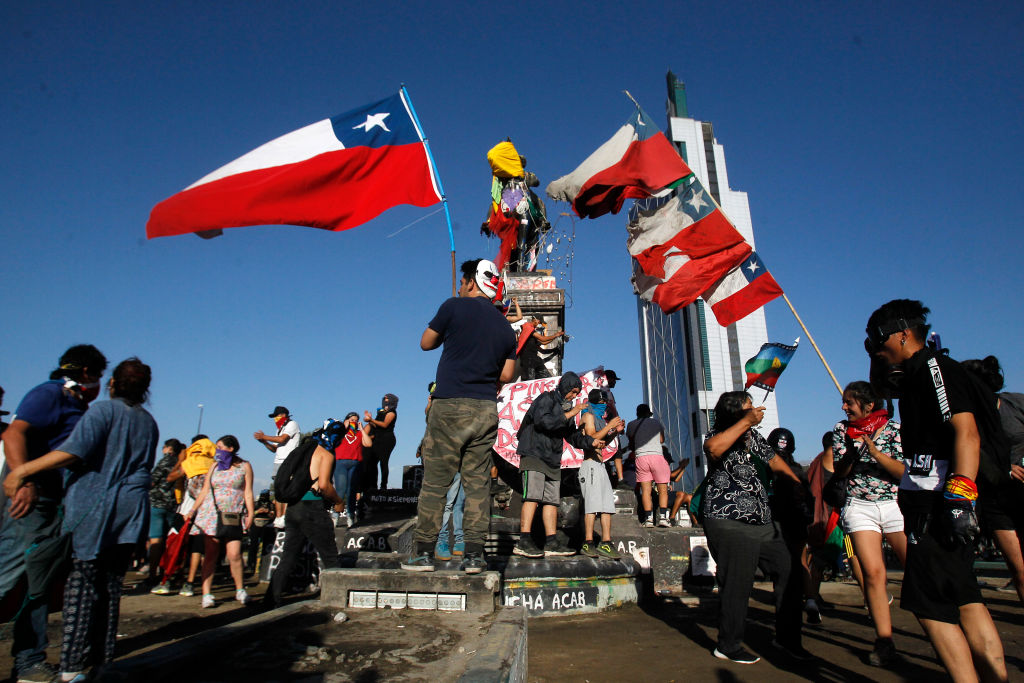
Demonstrators wave Chilean flags during protests against the government of President Sebastian Piñera who turns seventy on this day at Plaza Italia on December 1, 2019 in Santiago, Chile.Jonnathan Oyarzun Jara / Getty
The Chilean uprising is now in its second month. Piñera’s government is caught between right-wing calls for an even more authoritarian approach to contain the protests, and a left-popular movement that is calling with greater force for his resignation. Meanwhile, the nation’s Parliament has taken the entire country by surprise, announcing a plebiscite on a constituent assembly.
The agreement, which was reached at 2 AM on November 15, is in part the by-product of pressure from the streets. At the same time, it’s a response to military strong-arming. Unofficial information suggests that the military had two days earlier given forty-eight hours for a civilian resolution to the situation, before it would be given recourse to even bloodier forms of repression.
The agreement establishes two plebiscites: one to propose and another to confirm a constituent process. Constitutional change will be implemented either by a Constituent Convention (or assembly) elected entirely by universal suffrage, or by a Mixed Convention of elected and parliamentary members.