Podemos Is Finally in Government
After a failed early election gambit, Spain’s prime minister, Pedro Sánchez, has finally accepted Podemos into his government. It’s a huge achievement for the Left — and a way to free Spain of its sharpening nationalist tensions.
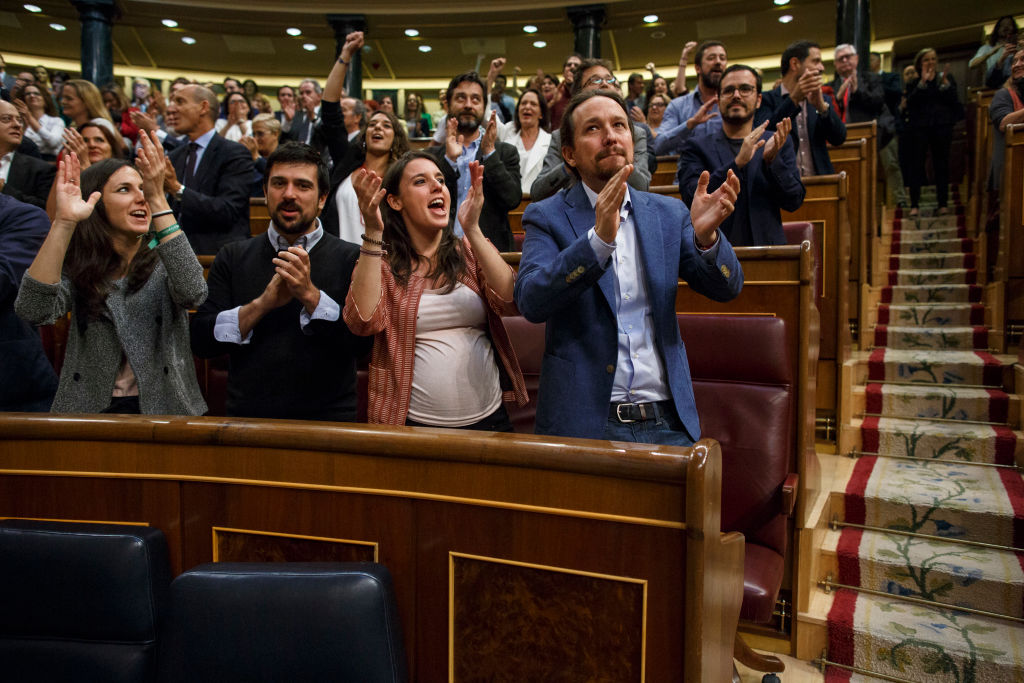
Pablo Iglesias (R), Irene Montero (2R), and other members of Podemos celebrate the result of the no-confidence motion at the Lower House of the Spanish Parliament on June 1, 2018 in Madrid, Spain. Pablo Blazquez Dominguez / Getty Images
“We are dismayed . . . We would prefer a centrist [grand coalition] between the [right-wing] Partido Popular and the Socialist Party, without extremes.” Such were the words of Spain’s association of corporate heads, Círculo de Empresarios, this Tuesday, when news filtered through of an agreement for a left-wing coalition uniting the center-left Socialist Workers’ Party (PSOE) and the radical-left Unidas Podemos.
For such business chiefs, the mere presence of Podemos’s thirty-five MPs in government inspires fear. As Podemos leader Pablo Iglesias put it, the policy concessions it forced from Pedro Sánchez’s PSOE minority government in last year’s budget deal — including a 22 percent minimum wage hike, rent controls, and restoration of slashed pensions — demonstrated its threat to commercial elites. Iglesias took aim at these faceless economic powers during the run-up to Sunday’s general election, making it a pillar of his campaign.
With news of a deal, Spain’s corporate and financial interests have reason to come out fighting. Over the summer, they successfully prevented a coalition between the two parties, applying sufficient pressure on acting prime minister Sánchez — aided by efforts from Brussels — to force him to walk away from negotiations. This triggered last Sunday’s repeat general election, the second in six months and the fourth in as many years. The aim of all this was to avoid Spain’s first left-wing coalition since the Second Republic of the 1930s.