“No Rape, No Base, No Tears”
The US military presence around the world doesn’t just create death and destruction — in places like Okinawa, Japan, its bases foster an environment of sexual violence against women.
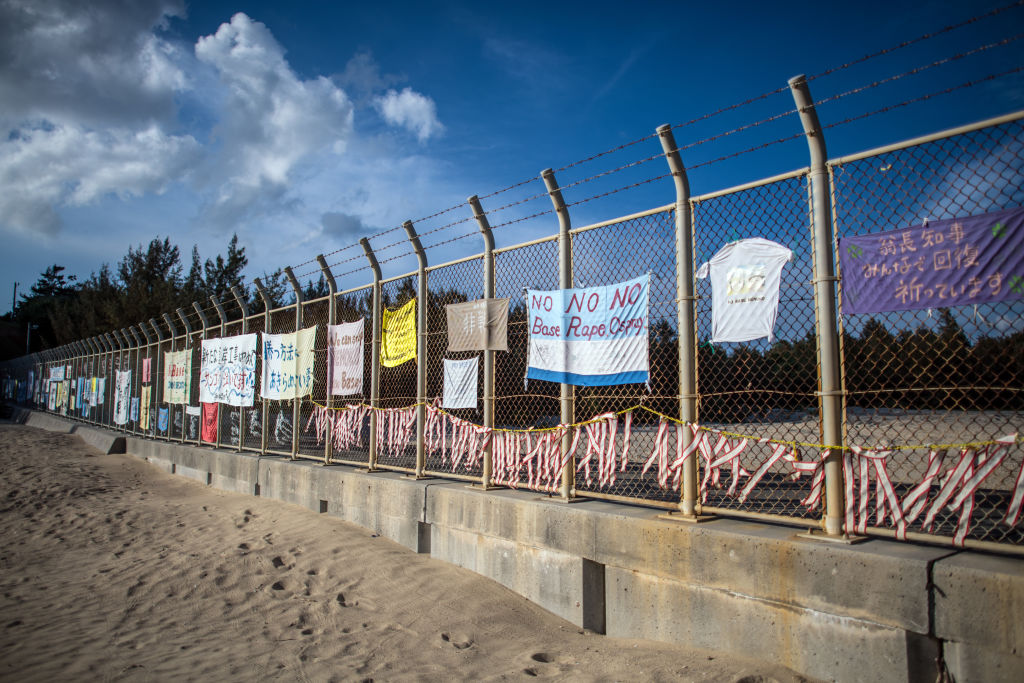
Protest banners hang on the perimeter fence of Camp Schwab, a United States military base on May 30, 2018 in Nago, Okinawa prefecture, Japan. Carl Court / Getty Images
The Mihama American Village shopping mall and theme park in Okinawa is off of Highway 58, across from Camp Lester (US Marine Corps) and midway between Kadena Air Base (US Air Force) and Camp Foster (Marines again). It’s twenty-six minutes by car from Torii Station (US Army) and thirty-five minutes from the White Beach Naval Facility (Marines again, plus support for the US Navy’s Seventh Fleet). The delights of the American Village are these: shopping at the American Depot, the chance to eat tacos and pizza, and most of all, going to the clubs, where young American Marines drink watery drinks and dance to American hip-hop, pushed up close to Okinawan women.
American Village is also half an hour by car from Camp Hansen, where, in 1995, three American servicemen kidnapped a twelve-year-old schoolgirl as she came out of a stationery store. They beat her, bound her hands and legs, and stored her in the car trunk while they drove her to the abandoned sugarcane fields, where they took turns raping her. When one of the men noticed her staring at them, he covered her eyes with duct tape. After being dumped on the road, bleeding and unconscious, the girl managed to crawl to help. Upon recovery, she took the extraordinary step of reporting the assault to the police. When the three servicemen — Marcus Gill, Rodrico Harp, and Kendrick Ledet — were caught, Gill explained that they hadn’t had any money for a sex worker. “Let’s go rape a girl,” he proposed. “It was just for fun.”
The case sparked a wave of anti-base activism in Okinawa that had been simmering for decades, including an anti-base rally that brought out more than half of the Okinawan population. Yet despite the efforts of women activists, governor Masahide Ōta began using the case to push his own agenda and prestige. Soon the rape had become an allegory to talk about Okinawa generally, and promises from Japanese and American lawmakers to close a Marine Corps station halted, while the governor quietly renewed the leases for the US bases on the island. Okinawan women were left where they had been before — civilians living their lives around the bases, military wives and girlfriends, workers and volunteers on the bases, hostesses and sex workers in the clubs, anti-base activists trying to make something change.