Is Democracy Doomed?
Research shows that the organized working class, and industrial workers in particular, have been the driving force for democracy around the world. The question is whether the erosion of the industrial working class will weaken our prospects for democratic politics.
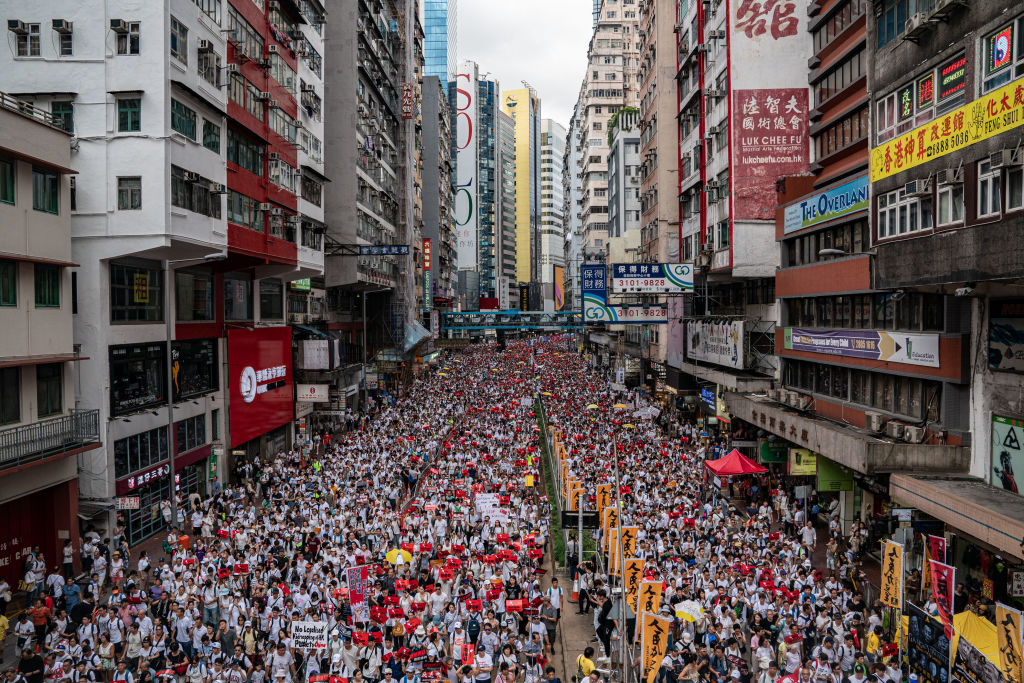
Protesters march on a street during a rally against the extradition law proposal on June 9, 2019 in Hong Kong.Anthony Kwan / Getty
2019 is shaping up to be a banner year for protest activity around the world. September’s global climate strike brought millions of people into the streets worldwide, with an estimated 2,500 actions taking place in over 160 countries. This was a historic event, but only one of many mass actions that have swept the world this year. The list of countries rocked by significant protest movements is long: Algeria, Brazil, the Czech Republic, Ecuador, Egypt, France, Hong Kong, Iraq, Kazakhstan, Puerto Rico, Russia, Serbia, South Africa, and Sudan, among others. They’ve recently been joined by Lebanon and Chile, where protesters outraged by inequality, the erosion of public services, and the failure of political representation have plunged their countries into turmoil. A long summer has spilled over into a hot autumn, and this wave of protest may well continue to roll on into the next year.
Have these protests been effective in achieving their goals? So far, the picture is mixed. Outside of Sudan, where mass demonstrations and strikes deposed Omar al-Bashir and initiated a political revolution, the protests have not yet produced much in the way of fundamental changes in the constitutional order. It may be too early to gauge their impact, but it seems likely that many will meet the same result as most protest movements: some combination of repression and concessions, while the incumbent political regime remains intact.
In country after country, the people want the fall of the regime, as the Arab Spring’s main slogan put it. If deposing governments were a matter of will, this would be relatively easy. But whether the people have the capacity to do so and, just as importantly, whether they have an interest in establishing a more democratic political system is a matter of social structure and class composition. Above all, it is a question of whether the working class is organized, strategically located, and capable of effectively wielding power.