The Reopening of the Irish Question
The historic prospect of Irish unification is now greater than it has been in decades. But it won’t succeed unless campaigners offer a clear and compelling picture of what a united Ireland will look like.
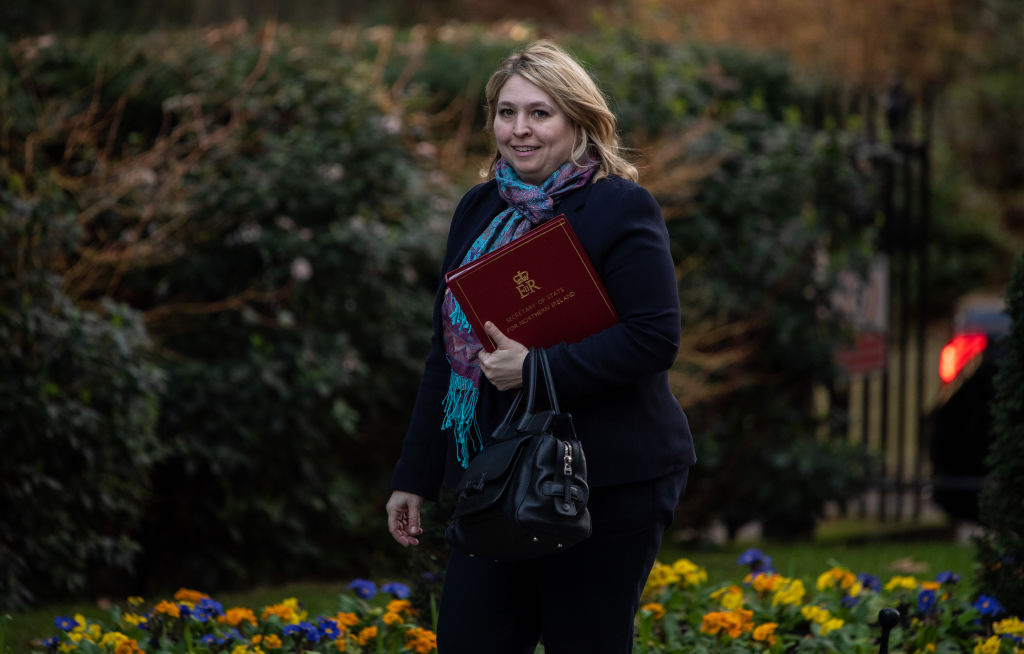
Secretary of State for Northern Ireland, Karen Bradley, arrives to attend the weekly cabinet meeting at 10 Downing Street on February 19, 2019 in London, England.Chris J Ratcliffe / Getty
It should be the aim of every public figure to navigate their professional life so as not to cause a “Controversies” tab to be added to their Wikipedia page. The UK Secretary of State for Northern Ireland, Karen Bradley, has not managed to escape such a fate, and two of the three controversies attributed to her relate to her tenure as Northern Ireland secretary. Back in September, she admitted she had no idea, prior to accepting the post, that Irish nationalists voted for nationalist parties and British unionists vote for unionist parties — the most obvious and basic facet of politics in the North.
Now, Bradley has been forced to “clarify” comments she made about deaths of civilians during The Troubles, the three decades of communal violence in Northern Ireland that formally ended with the 1998 Good Friday Agreement. After initially claiming that British soldiers who had killed civilians had not committed crimes — they were “people fulfilling their duties in a dignified and appropriate way . . . They were people acting under orders” — she attempted to row back on the comments within half an hour, before claiming the following day, “I do not believe what I said, that is not my view.” Regardless, her comments are widely seen as so out of touch and incendiary that calls for her resignation still refuse to abate.
The comments come during the inquest into the 1971 Ballymurphy Massacre, which saw eleven people killed by soldiers over three days, and shortly before a decision is set to be reached on whether to charge soldiers over fourteen killings in the 1972 Bloody Sunday massacre. Briege Voyle, the daughter of Ballymurphy victim Joan Connolly, condemned the comments outside the Belfast coroners court. “We had to sit in there yesterday, me and my sisters, and listen to the horrific things that those soldiers did to my mummy. Blew half her face off, shot her in the thigh, shot her in the hand,” she said. “And she’s telling me these soldiers did this with dignity? Where was the dignity in that?” The relatives of victims of British soldiers don’t consider their family members to have been murdered in a “dignified and appropriate way,” and such comments would ordinarily be a swift resigning issue for a minister.