Behind Modi’s Blackout in Kashmir
A Jacobin contributor in Kashmir interviewed dozens of ordinary Kashmiris in the midst of Modi’s brutal communications clampdown on the region. Despite the Indian government’s best efforts, Kashmiris’ demands for self-determination cannot stay invisible forever.
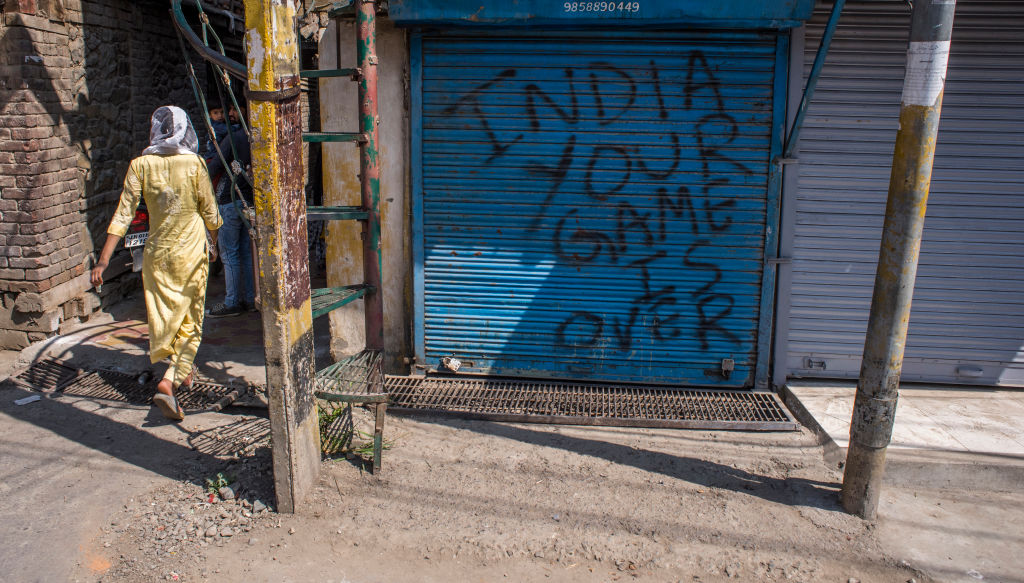
A Kashmiri Muslim woman walks in front a graffiti written on a shuttered shop by Kashmirs in the old city after the revocation of special status, on September 19, 2019 in Srinagar, the summer capital of Indian administered Kashmir, India. (Yawar Nazir / Getty Images)
On August 5, the Indian government, led by prime minister Narendra Modi and his Hindu nationalist Bharatiya Janata Party (BJP), abrogated Article 370 of the Indian constitution. Article 370 has accorded a special status to the northern state of Jammu and Kashmir since 1947, including a separate constitution, autonomy over internal administrative matters, and under which only permanent residents were afforded property and franchise rights.
As Samreen Mushtaq and Musadir Amin explain, while Article 370 was illegitimate for granting India power over Kashmir in the first place, it at least articulated some (frequently violated) rights for Kashmiris. Now, “with the article gone, there is nothing tethering Kashmir to India, save for its imperialist designs and settler colonialist goals. Once Kashmir’s land is available for anyone from India to buy, Kashmiris worry that it won’t be long before they’re displaced from their home.”
Modi knows there is no democratic basis for such a radical imposition of the Indian government’s power over Kashmir, so he is carrying out Article 370’s abrogation by force. The Indian government has imposed a communications blackout on Kashmir, suspending internet and phone services, all enforced by paramilitary rule. He is hoping to make Kashmir, and Kashmiris, invisible to the wider world, so that he can carry out his political agenda in the region while news agencies continue to regale India as “the world’s largest democracy.”