The Indian Occupation of Kashmir Is Only Getting Worse
A report from inside Kashmir, where Indian authorities have created an open-air prison with millions captive.
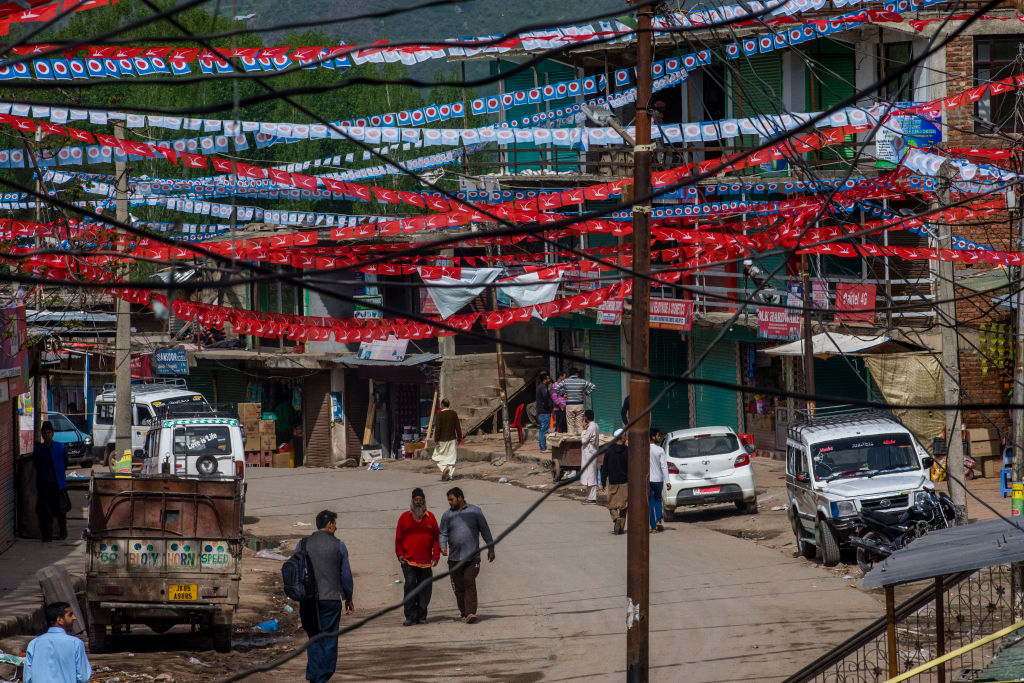
A view of a closed market during the first phase of the elections of the lower house of the Indian parliament, on April 11, 2019 in Uri. northwest of Srinagar, Kashmir, India.Yawar Nazir / Getty
We spent five days (August 9–13, 2019) traveling extensively in Kashmir. Our visit began on four days after the Indian government abrogated Articles 370 and 35A, dissolved the state of Jammu and Kashmir (J&K), and bifurcated it into two Union Territories.
When we arrived in Srinagar on August 9, we found the city silenced and desolated by curfew, and bristling with Indian military and paramilitary presence. The curfew was total, as it had been since August 5. The streets of Srinagar were empty, and all institutions and establishments were closed (shops, schools, libraries, petrol pumps, government offices, banks). Only some ATMs and chemists’ shops — and all police stations — were open. People were moving about in ones and twos here and there, but not in groups.
We traveled widely, inside and outside Srinagar — far beyond the small enclave (in the center of Srinagar) where the Indian media operates. In that small enclave, a semblance of normalcy returns from time to time, and this has enabled the Indian media to claim that life in Kashmir is back to normal. Nothing could be further from the truth.