How Decades of Neoliberalism Led to the Era of Right-Wing Populism
Right-wing neoliberalism’s assault on the very idea of society laid the groundwork for today’s right-wing nationalist backlash. But the Left’s hands aren’t entirely clean either.
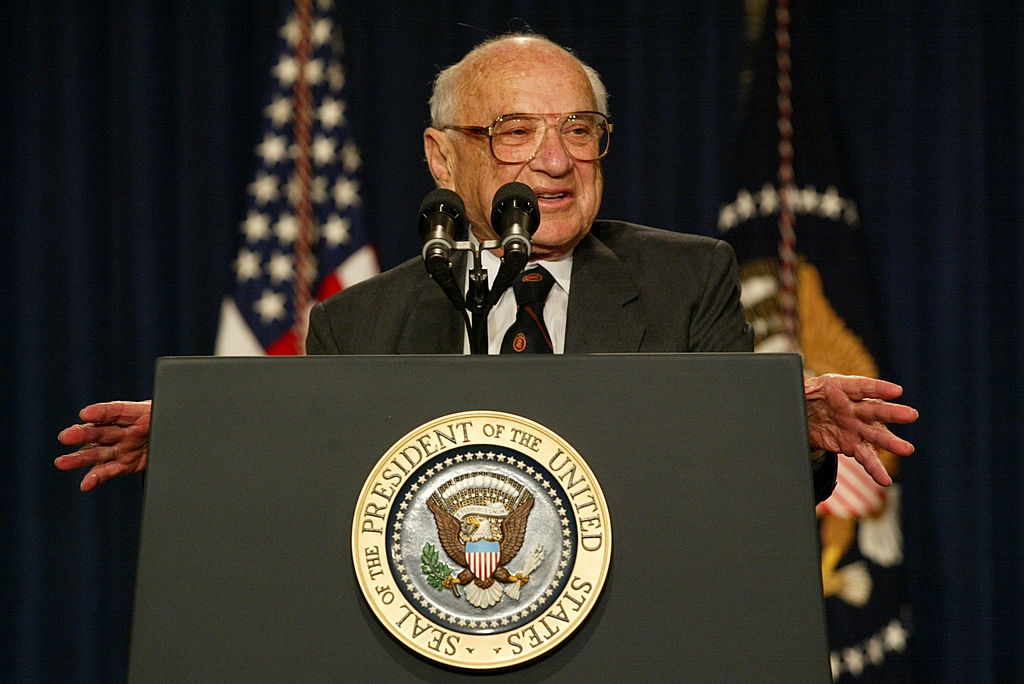
Milton Friedman speaks on May 9, 2002 during a White House event in Washington, DC.Alex Wong / Getty
In the heated year of 1968, the Chicago economist and Nobel Prize winner George J. Stigler jotted down some thoughts on how to introduce the “price system” into the process of democracy. Stigler had been one of Milton Friedman’s closest friends and part of his neoliberal “thought collective” since its inception. Both men participated in the first meeting of the Mont Pèlerin society in 1947, one of the founding events of the neoliberal movement. In the following decades, the two Chicago economists made vital contributions to what, according to Wendy Brown, became the overriding objective of the worldwide neoliberal agenda: “the economization of all features of life,” a project that sought to substitute the price system for more political forms of collective decision-making.
Stigler proposed a particular mode for this “economization.” He had already previously provided cost/benefit models to, for example, probe the “optimal” rate of car accidents or to ask if it would be more optimal to bomb Japan “continuously” or “discontinuously” in war time. From that point of view, shouldn’t we also view democracy itself as having a “cost” and needing to be run in the most efficient way? The cost of periodic elections, Stigler thought, was generally too high and “distracting” with all its “unnecessary campaigns.” Unlike in a private company, the terms of employment for elected officials were limited in time. “The costs of ‘rehiring’ elected officeholders,” he argued, were excessive and superfluous as long as voters were satisfied with their elected officials. Perhaps surprisingly, the “abandonment of periodic elections” became for Stigler a more rational way of organizing political representation, bringing it into closer alignment with “orderly economic life.” It was always “costly to discover, examine, and train a new worker, and the worker finds it costly to discover, explore, and move to a new job,” he followed. Why not, as in the private sector, “adopt the rule of indefinite tenure?” With a presidential term understood as a simple employment contract, a president could then stay in power as long as his employers — read, citizens — want him there. Voters, Stigler proposed, could call an election by means of a petition requiring one-tenth of the electorate to sign on. In today’s demographic terms, this would represent more than 20 million voters.
Furthermore, to avoid an excess of elections (“excessive” democracy could easily degenerate into totalitarianism), Stigler added that “the petitioners for a new election would pay its costs to the state.” This “introduction of the price system” into the democratic process would allow for it to “become responsive to the desires of the electorate and the costs of elections.” Implementing such a system would, of course, imply a very strict containment of politics and democracy, making even elections difficult to organize; considering the “cost” of an election, only the wealthy or corporations would then have the resources to contest elected officials. “Politics” in the classical sense would thus be, to take Hayek’s expression, “dethroned,” making the vast majority of citizens unable to shape the social order collectively.