Selling Out Julian Assange
By granting asylum to Julian Assange in 2012, Ecuadorian president Rafael Correa made clear his country would no longer bow to US diktats. The decision this spring to allow Assange's arrest shows how far Ecuador's challenge to empire has faded.
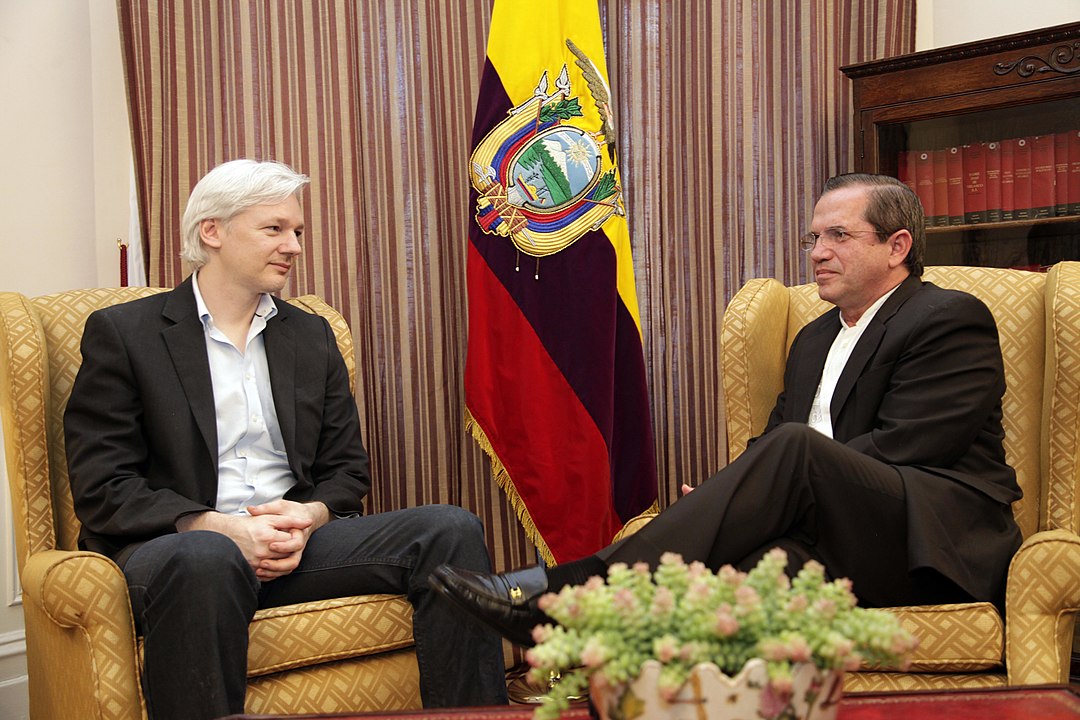
Ecuadoran foreign minister Ricardo Patiño meets with Julian Assange at the Ecuadorian Embassy on June 16, 2013. Xavier Granja Cedeño
When Julian Assange was arrested at the Ecuadorian embassy in London in April, the country’s former left-wing president Rafael Correa knew who to blame. According to Correa, his successor Lenin Moreno — vice-president during Correa’s own presidency — “had sold Assange to the United States.” He accused the new president of having “displayed a pathological hatred” of the Wikileaks founder, after his website had revealed details of a corruption scandal involving Moreno’s family.
Correa’s decision to grant Assange asylum in 2012 came at the height of Latin America’s Pink Tide, as progressive governments across the continent challenged US interference in the region. Assange’s arrest six and a half years later comes as the Latin American left is in open retreat, underscoring the rupture between Correa’s presidency and that of his party’s chosen successor. When Moreno secured electoral victory in 2017, the country seemed to be bucking the wider reactionary trend in the region. But upon taking office the new president quickly turned to the Right — implementing a conservative economic agenda that has seen poverty levels rising anew.
To examine Ecuador’s approach to the Assange case and how its position has evolved over the last seven years, Eoghan Gilmartin and Tommy Greene sat down with Txema Guijarro. Currently an MP for Spain’s radical-left Podemos party, Guijarro previously worked as an advisor to the Ecuadorian Foreign Minister Ricardo Patiño. In 2012, he spent several months in London charged with organizing Assange’s asylum, before being sent to Moscow the following year to facilitate Edward Snowden’s abortive efforts to reach Latin America. As he tells Jacobin, Moreno’s opposition to Assange’s asylum pre-dates his presidency and was already evident as early as 2012.