The SPD Must Change Course or Die
- Loren Balhorn
The Social Democrats’ subordination to Angela Merkel has brought the German center-left to its knees. If the party wants to stop its voters from fleeing to the Greens and the far right, it needs to decide what side it’s on — and fight for it.
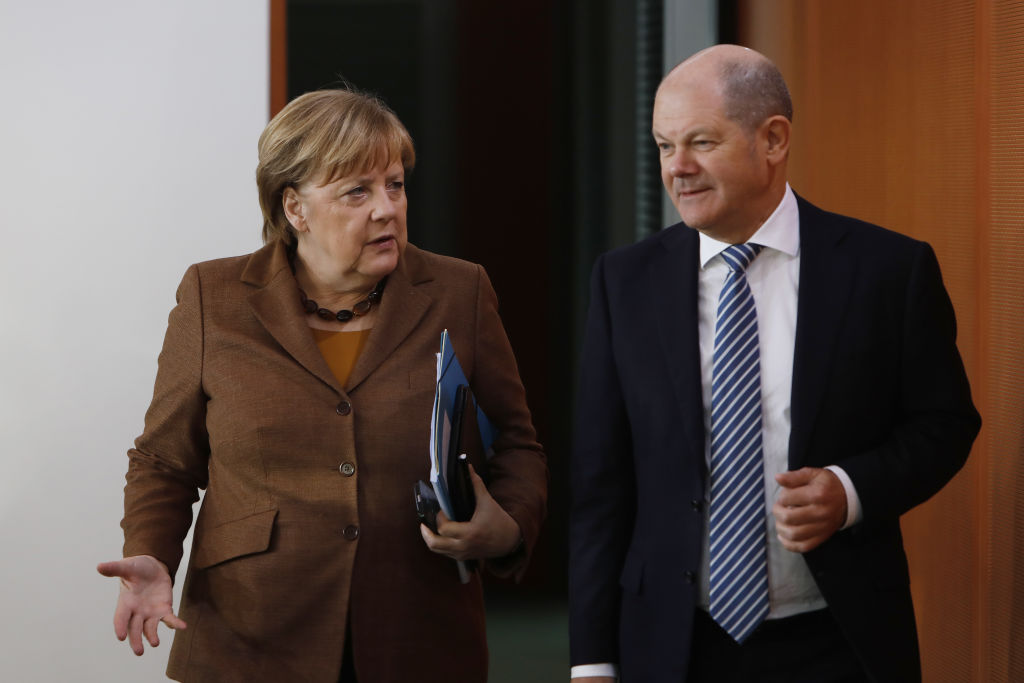
German chancellor Angela Merkel and vice chancellor, Olaf Scholz (SPD), arrive for the weekly government cabinet meeting on January 30, 2019 in Berlin. Michele Tantussi / Getty
Germany’s oldest political party, the Social Democratic Party (SPD), is today trapped in a seemingly irreversible downward spiral. The party’s latest calamity came at the end of May, as it slumped to a crushing defeat in the European elections. After the results came in, leader Andrea Nahles announced her resignation, explaining that she would be departing the political stage in order to make way for “renewal” at the top of the party. With the loss of yet another short-lived leader, a three-person commission has now taken the reins while the SPD plots what to do next.
Nahles is just the latest casualty of a deeper crisis in the SPD, as the party struggles to shore up its weakened brand or appeal to an increasingly alienated electorate. As other ideas for reviving the party flounder, SPD elites have floated the idea of a membership-wide ballot to choose the next chairperson and perhaps even a co-chairpersonship split between a man and a woman. But with the party still caught in a grand coalition with Angela Merkel’s Christian Democrats (CDU) and its leadership largely populated by out-of-touch careerists and bureaucrats, it seems unlikely that merely cosmetic changes will lift the party out of its rut.
However, the SPD is not simply a monolith, and a minority of party functionaries are pressuring the leadership to take bolder, more radical action. One such figure is the Social Democratic member of parliament Hilde Mattheis. Having joined the party as a schoolteacher in the 1980s, she spent years active at the local level in her hometown of Ulm, rising up the ranks of the SPD women’s organization before entering the state leadership and becoming a member of parliament in 2002. From the outset a sharp critic of the party’s turn to the center, since 2011 she has served as chairwoman of the “Forum Demokratische Linke” (DL21), the main current representing the SPD’s left wing.