Can Anyone Save the SPD?
- Loren Balhorn
As its voter base collapses, Germany’s once-mass Social Democratic Party appears to be headed into the political abyss. To make things worse, its leaders think the answer lies in a further shift to the right.
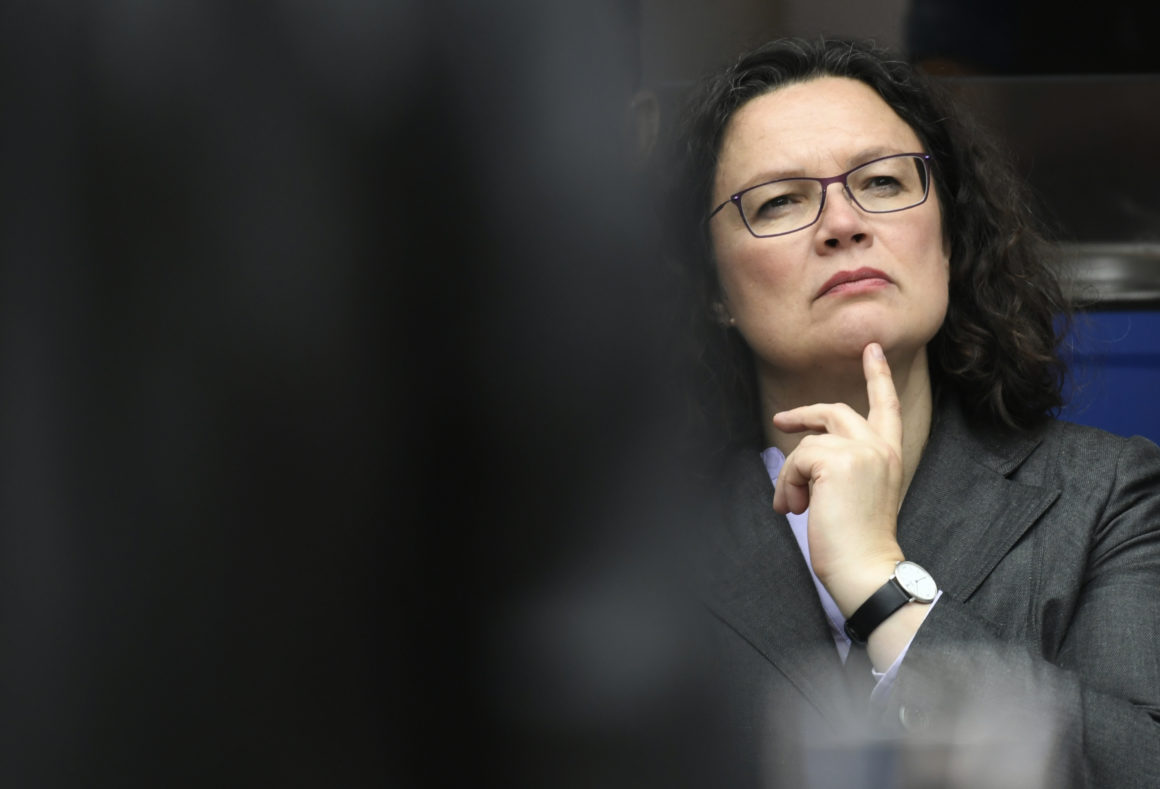
German Social Democratic Party (SPD) leader Andrea Nahles, attends an election campaign rally for the 2019 European elections on May 22, 2019 in Duesseldorf, western Germany.Ina Fassbender / AFP / Getty
The public response was notably muted when Andrea Nahles stepped down from her positions as party and parliamentary leader of the Social Democratic Party (SPD) last Sunday — even her political opponents had little comment. Nahles had been the first woman in history to occupy the position and was given the impossible mission of “renewing” the party’s image while remaining in a grand coalition with Angela Merkel’s Christian Democrats (CDU). To outside observers it quickly became apparent that the whole endeavor was doomed to fail, and her resignation thus provoked understandably little public malice.
But what comes next? The contradiction that broke Nahles — the need to renew the SPD while simultaneously governing with the conservative CDU — remains as urgent as ever. And this also means that no one is particularly keen to occupy the newly vacated leadership spots. In the immediate term, the party will be led by a three-person commission consisting of Malu Dreyer, minister-president of Rhineland-Palatinate, Manuela Schwesig, minister-president of Mecklenburg-Western Pomerania, and Thorsten Schäfer-Gümbel, outgoing SPD parliamentary speaker in Hesse. All three emphasize that their appointment is temporary. Finance minister Olaf Scholz also turned down the job, and the party’s uppermost layers continue to grow noticeably thinner.
Memes Aren’t Enough
Even before the European elections it was obvious this moment was coming. The Social Democrats threw justice minister Katarina Barley into the electoral fray to exuberantly sing the praises of a “social Europe,” while in government the party was sparring with Angela Merkel over every last crumb of social spending. Barley was thus presented with a similarly impossible political task, made even worse by a superficial and embarrassing social media campaign that hurt the SPD more than it helped.