God and Mammon at Loyola
At Loyola University, graduate workers aren’t just fighting for better conditions. They’re challenging the neoliberalization of one of Chicago’s leading Catholic institutions.
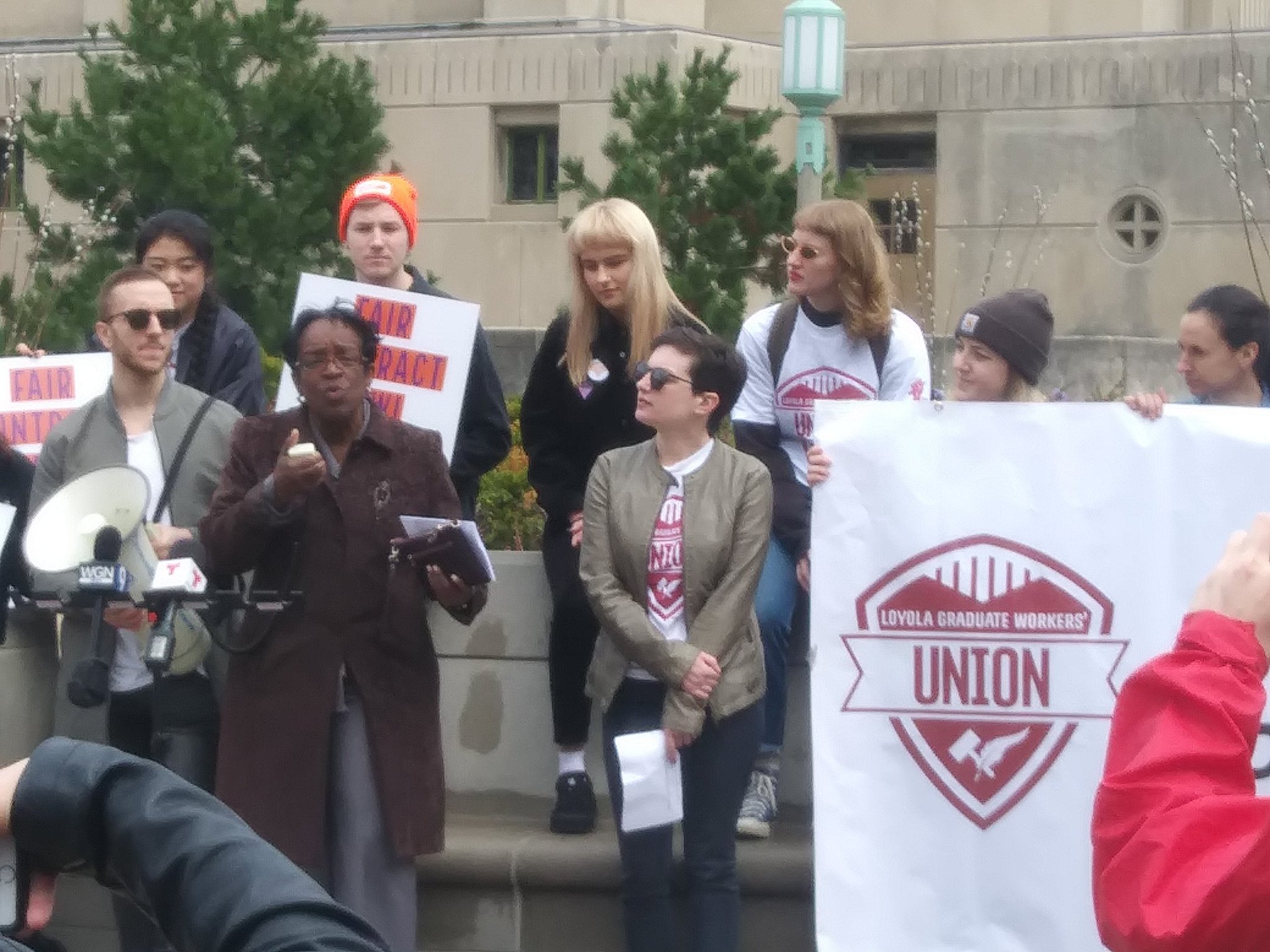
President Dian Palmer of SEIU Local 73 speaks at a Loyola Graduate Workers Union rally on April 24, 2019. Photo: LUC Worker Coalition.
On Monday, April 15, as the Notre Dame Cathedral went ablaze in Paris, workers at one of Chicago’s foremost Catholic institutions asked to have their union recognized. More than sixty of them marched, from the lake shore, through one of the city’s wealthiest neighborhoods, to Loyola University’s Lewis Towers. The towers, where the school’s highest decisions are made, are located several miles south of Loyola’s primary campus in Rogers Park. Those marching were seeking to ask — once again — to be met at the negotiating table by university president Jo Ann Rooney. When denied this opportunity yet again, the group peacefully blocked the towers’ entrance and made speeches before police arrested a handful who still refused to move.
Since 2016, the school has opposed the National Labor Relations Board’s decision that graduate workers can unionize, contending that graduate students and PhD candidates grading papers, doing research, and teaching their own courses are to be classified strictly as students, not workers. Once the area in front of the towers cleared, Thomas J. Regan, dean of the graduate school, approached an array of local news microphones to repeat the tired line that the school does negotiate in good faith — but only with workers, not students. This group, he maintained, was the latter.
This claim is a fragile one. Given Loyola’s tuition prices, how would the school explain to students and parents why it uses a group that isn’t ready for adequate compensation to serve as the backbone of its day-to-day teaching? There is an unbridgeable gap between Loyola’s claim to offer a quality education and the notion that the people providing that education are not qualified enough to sit at a table where they might speak practically about how they’re treated.