The Attack on Public Housing
Public housing should embody a promise: free housing for all, free of segregation. Reserving it only for the poorest undermines that promise.
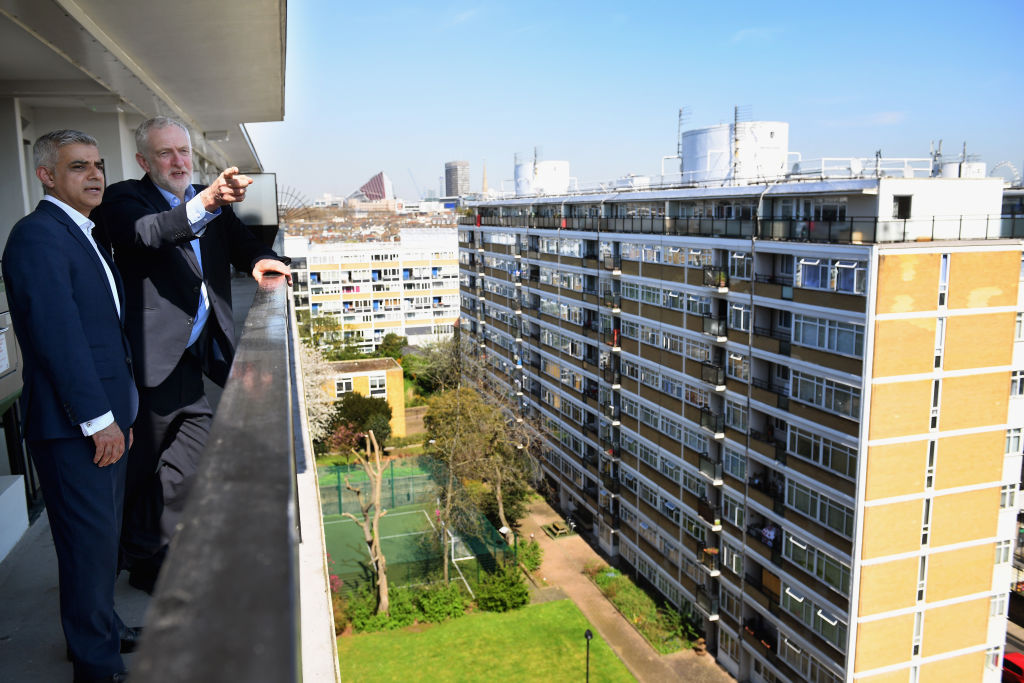
Labour leader Jeremy Corbyn and Mayor of London Sadiq Khan visit the Churchill Gardens Estate in Westminster on April 19, 2018 in London, England. The visit was following the launch of the Labour party’s Social Housing review and Green Paper consultation which sets out their ambition to build one million affordable homes over a ten year period, including the biggest council house-building program for over 30 years. Jeff J Mitchell / Getty Images
The spirit of Christmas is alive and well in the British media: on Christmas Eve, the left-leaning tabloid the Mirror published a story slamming the Labour member of Parliament Kate Osamor for living in social housing despite earning £77,000. Osamor tweeted in response, “On Christmas eve, I will always remember that nearly 30 years ago I was a homeless single mum who secured a tenancy to my home. Everyone deserves a home for life. I remain proud, not ashamed, to be in social housing.” The Edmonton MP shares the home with her son, who worked for Osamor and was a Labour councilor until he resigned following a drug conviction earlier this year, which led to his mother’s resignation as a shadow minister after an altercation with a news reporter for the Sunday Times.
The Mirror’s argument, and that picked up by the right and center, follows the familiar line that social housing should only ever be reserved for the very poorest: any change in circumstances for the better should necessitate eviction and tenants should be forced into the private sector. The late Bob Crow, then leader of the RMT transport workers’ union, came under regular attacks for refusing to move out of the council home he lived in and stated categorically he had no moral duty to do so. Crow was right: public housing was designed to build mixed communities and replace the appalling private-sector housing that plagued Britain in the twentieth century. Slum housing throughout the United Kingdom was so poor that in both world wars, army officials were horrified at the state of conscripted soldiers’ health.
The establishment of the National Health Service (NHS) and the mass construction of millions of council homes were two of the most immediate concerns of postwar Britain: Nye Bevan, the Labour minister for both health and housing, saw the two commitments as essential to addressing rampant inequality in a country scarred by a cumulative decade of fighting. But while the NHS has maintained free at the point of use, social housing has been torn asunder, first by Margaret Thatcher’s government, then through inaction by New Labour, and now by a renewed attack by the Conservatives.