What the Show Trials Show
The sedition charges against Catalan independence activists mark a shameful moment for Spanish democracy. Franco’s regime is long gone, but the state machine he created has not been fully broken.
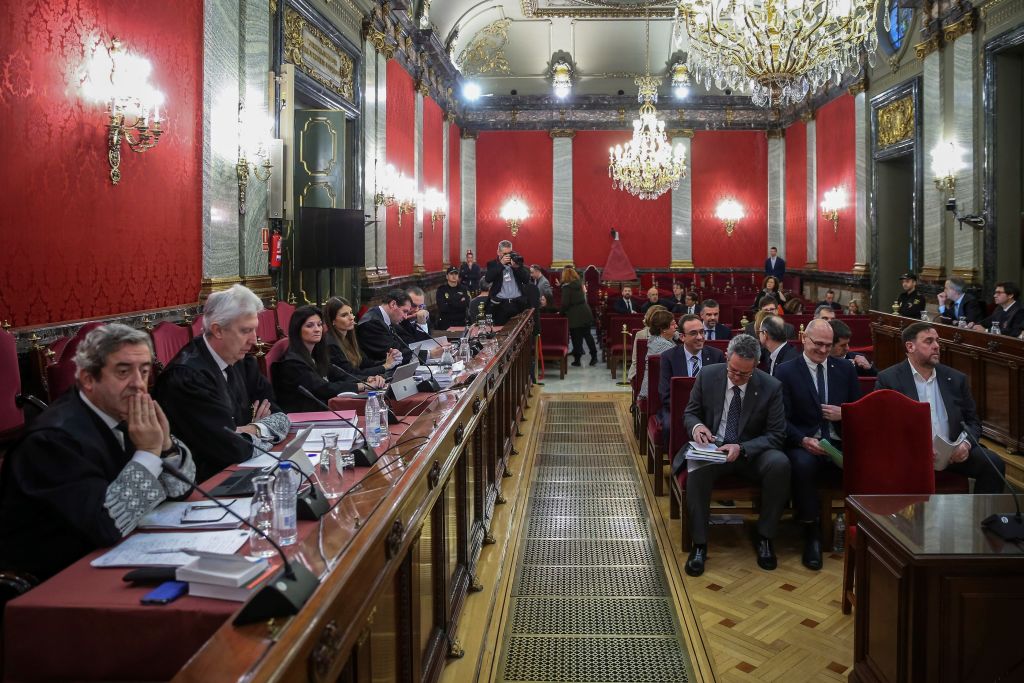
Catalan independence leaders at the beginning of their trial at the Supreme Court on February 12, 2019 in Madrid, SpainEmilio Naranjo– Pool / Getty
In January, Ignasi Sabater, the left-wing mayor of the small Catalan town of Verges, was arrested in a dawn raid. In the same police operation, another mayor, a journalist from the magazine La Directa, and thirteen other activists were rounded up and arrested because they had organized peaceful protests to demand the release of political prisoners. Sabater was pulled before a court and accused of “hate crimes” and “discrimination” against “the Spanish nation and the corps of the Guardia Civil.” Similar charges were leveled against politicians, teachers, and firefighters. Many ordinary people who have dared to condemn police violence — or even talk about it in public — have been hauled in front of the judiciary, facing prison for “hate crimes” against the Spanish state. A shocking development, this, in twenty-first-century Europe.
When Spanish police tried to put a halt to the Catalan independence referendum eighteen months ago, Roger Espanyol lost an eye to a rubber bullet. He vividly recalled the atmosphere of repression: “I remember the Spanish National Police taking the ballot boxes, putting the in the vans. And then, without any warning, they started to charge, with sticks, and then everything started. At the moment of the impact we were waiting for the Police to leave. Thats all I remember. I don’t know how or when I heard a shot.” More than a year on, the mass mobilization of militarized police to stop people voting feels somehow unbelievable.
Yet we can see similarly incredible scenes today. Last week the Spanish courts continued their show trial of Catalan leaders charged with “sedition” for their role in organizing the October 2017 referendum. Some Spaniards have shown their solidarity with the prisoners: on March 18, one hundred thousand people marched in Madrid to demand an end to state repression and support Catalans’ right to determine their future. Yet if on that march leftists from the capital, trade unionists from Asturias, and rural laborers from Andalusia all took a clear stance, the Spanish state’s disdain for basic democratic standards has taken many observers by surprise.