Spain’s Troubled Spring
Unable to pass its budget, Spain’s Socialist government is calling snap elections. But reactionary forces are on the rise in the country.
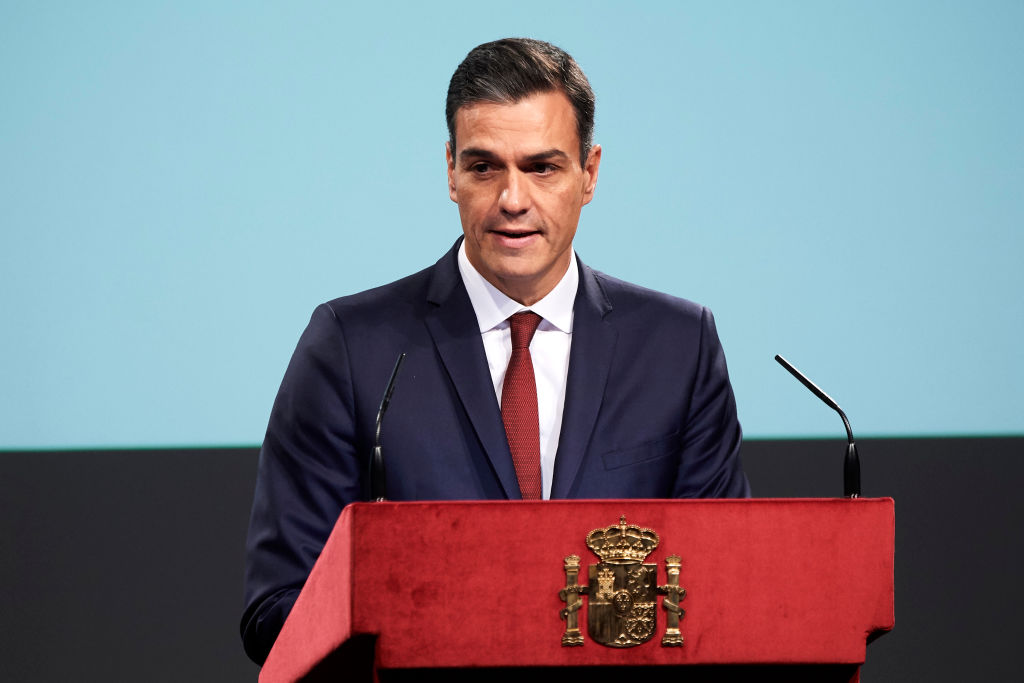
Prime Minister Pedro Sanchez attends the reading of the Spanish Constitution for the 40th anniversary of its approval by the Congress at the Cervantes Institute on October 31, 2018 in Madrid, Spain. Carlos Alvarez / Getty Images
It’s been a rough ride. On June 2, 2018, the Socialist Party (PSOE) leader Pedro Sánchez was sworn in as the twelfth head of the Spanish government since the end of the dictatorship. Yet the temporary allies who voted him into office were far more united in kicking out right-wing premier Mariano Rajoy than in supporting the new administration. Sánchez was backed by Unidos Podemos and its regional allies, almost without conditions but also by parties of both left and right from the Basque Country and Catalonia.
From the outset, both Rajoy’s Partido Popular (PP) and Albert Rivera’s Ciudadanos sharply criticized Sánchez’s alliance with these pro-independence and nationalist forces. Their attacks whipped up the traditional specters of the Spanish right, not just the fight for independence but also terrorist outrages by ETA (which dissolved two years ago) and the “far left” supposedly represented by Podemos. Thus from the start of its spell in office the PSOE faced a difficult balancing act, and a majority that was sure to be hard to maintain.
Sánchez responded to this difficult situation by forming a diverse cabinet, seeking to satisfy everyone (albeit at the risk of leaving everyone unhappy). His government was based on total gender parity, as well as the inclusion of several open gay ministers. Yet it also included figures who took a hardline anti-independence stance, from Interior Minister Grande Marlaska to Foreign Minister Josep Borrell, a figurehead of the unionist marches in Barcelona together with the Spanish-nationalist PP and Ciudadanos and the far-right Vox.