Macron’s Selective Antiracism
Emmanuel Macron has described anti-Zionism as a new form of antisemitism. Yet by associating all French Jews with the state of Israel, he risks fueling resentment between the victims of racism.
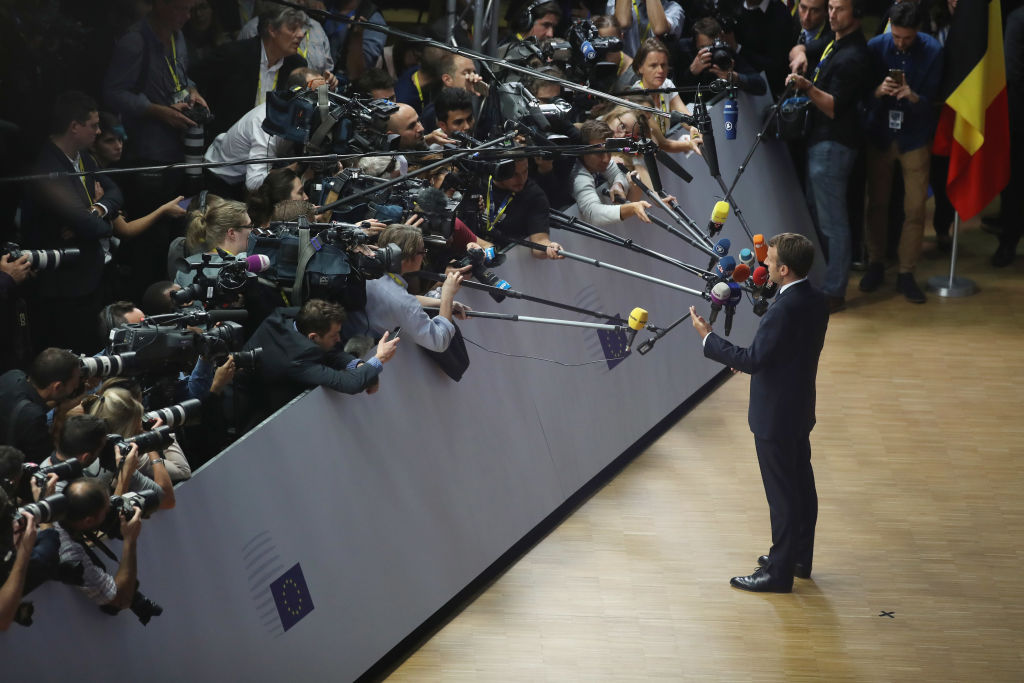
French President Emmanuel Macron arrives at the October Euro Summit on October 17, 2018 in Brussels, Belgium. Sean Gallup / Getty Images
If we take Emmanuel Macron’s word for it, France has an increasing problem with antisemitism. Last week the president addressed the country’s Representative Council of Jewish Organizations, declaring a rise in antisemitism “without precedent since World War II.” Already on February 11 his interior minister had reported that 2018 saw a 74 percent rise in attacks on Jews. Government sources have also linked this development to the gilets jaunes protests, as ministers blamed this “brown plague” for the racist vandalization of a Paris bagel shop and recent attacks on journalists.
Yet many French Jews are critical of this attempt to weaponize antisemitism claims. The reports of gilets jaune involvement in the bagel shop attack soon proved unfounded, and the president’s attempt to deem anti-Zionism a new form of antisemitism have blurred the distinction between Jews and Israel. At the same time, antiracist Jews have emphasized the dangers of a double-standard approach which fails to take Islamophobia and anti-black racism as seriously as antisemitism.
For Maxime Benatouil, a leading member of the French-Jewish Union for Peace (UJFP), the fight against antisemitism has to be combined with a consistent defense of minorities. He spoke to Jacobin’s David Broder about the presence of antisemitic attitudes among the gilets jaunes protests, Macron’s bid to weaponize attacks on Jews, and the danger of setting minorities against one another.