Julián Castro’s Early, Neoliberal Years
If Castro is indeed the “Latino Obama,” it's because his early years in San Antonio replicated many of the ingredients of the former president's recipe for failure.
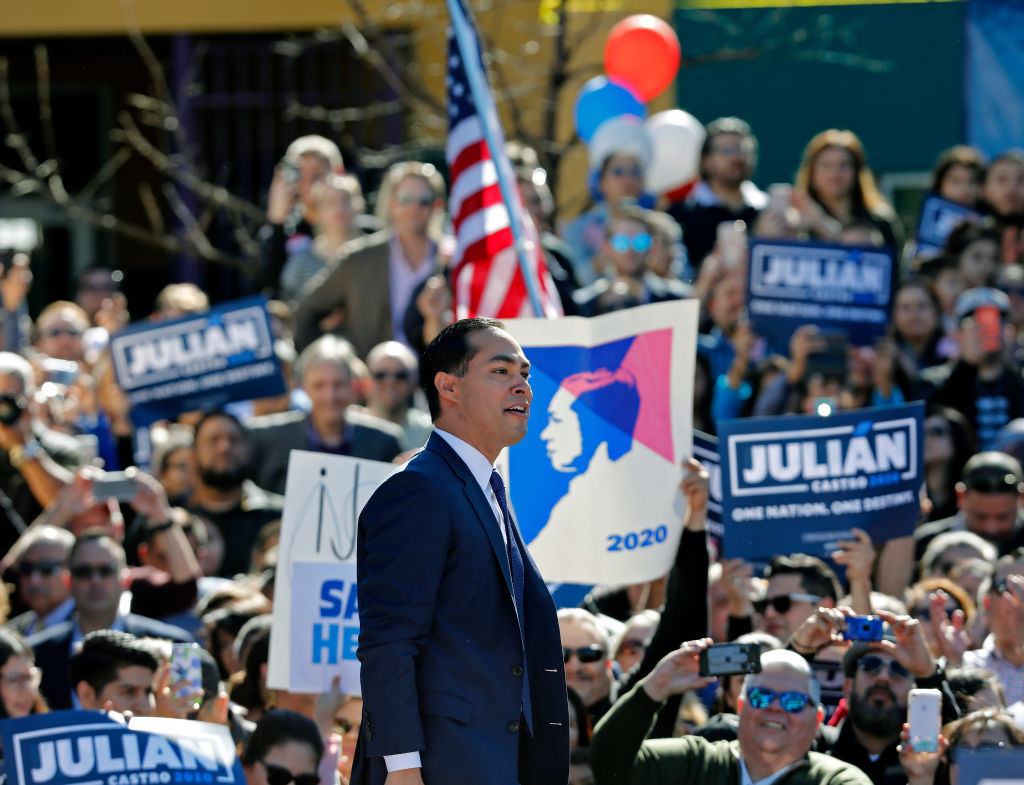
Julian Castro, former U.S. Department of Housing and Urban Development (HUD) Secretary and San Antonio Mayor, announces his candidacy for president in 2020, at Plaza Guadalupe on January 12, 2019 in San Antonio, Texas. Edward A. Ornelas / Getty Images
It was only a matter of time before Julián Castro threw his hat in the 2020 ring. Talked about as the “Latino Obama” for at least seven years now, Castro and his twin brother, current Texas congressman Joaquin, have long been slated for big things within the Democratic Party.
The moniker is more fitting than just a crude reference to the brothers’ future in an ever more diverse party. More than just about every other Democratic candidate in 2020, Castro is the quintessential Obama-esque candidate. Though thirteen years younger he is a young, ambitious Harvard Law graduate who entered politics at the tail end of the Clinton era (1997 for Obama, 2000 for Castro) and made a national splash via a high-profile Democratic National Convention speaking slot (2004 for Obama, 2012 for Castro).
More importantly, Castro absorbed many of the political lessons and much of the approach that defined both Obama’s time in the White House and the years preceding it: a technocratic, business-friendly style aiming to work squarely within existing political orthodoxy, stress consensus over class war, and one that often gave short shrift to the working class.