An Authoritarian Bromance
Trump and Bolsonaro aren’t just united by their shared prejudices, but by a sense of common purpose.
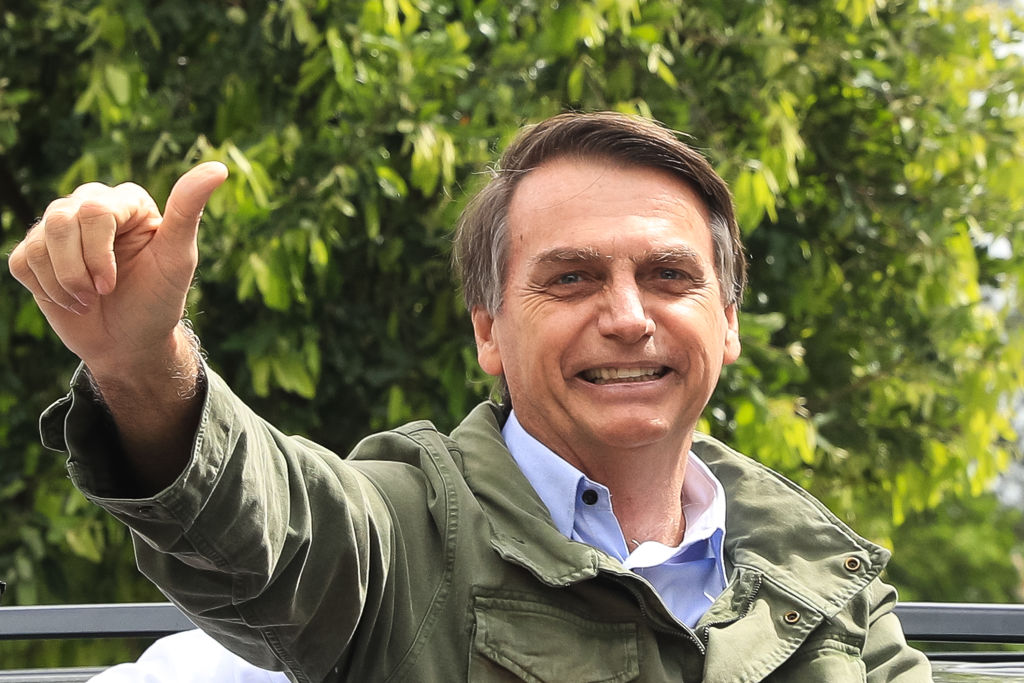
Jair Bolsonaro gestures after casting his vote during general elections on October 28, 2018 in Rio de Janeiro, Brazil.Buda Mendes / Getty
Donald Trump is a reliable friend to authoritarian despots, and he recently found a new bedfellow. Brazil’s new president, Jair Bolsonaro, has a history of outrageous comments on everything from indigenous and LGBT rights to democracy itself that make Trump look statesmanlike in comparison. Trump appears unconcerned with aligning himself with such hate speech. “Congratulations to President @JairBolsonaro” he tweeted on January 1, when Bolsonaro took office. “The U.S.A. is with you!” Bolsonaro responded effusively: “Dear Mr. President @realDonaldTrump, I truly appreciate your words of encouragement. Together, under God’s protection, we shall bring prosperity and progress to our people!”
The emerging “bromance” between the right-wing presidents of the Americas’ largest countries is in line with the friendly relationships Trump has developed with leaders like Iván Duque of Colombia and Mauricio Macri of Argentina. In the case of Colombia, the areas of cooperation between the US and its most stalwart ally in the region are the same as ever — counter-narcotics, counterterrorism, and continued opposition to the government of Venezuela.
Trump’s relationship with Bolsonaro is different, however, in that Brazil has seldom been a consistent US ally. The countries have sparred over issues such as trade, Brazil’s pursuit of nuclear energy in the 1970s, and the country’s desire to take a leadership position in Latin America. Under presidents Luiz Inácio Lula da Silva and Dilma Rousseff, the relationship between the US and Brazil was frequently strained. Brazil sought alliances with other leftist governments in the region and increased trade with China and other BRICS countries, while playing a key role in torpedoing Washington’s aspiration for a Free Trade Area of the Americas. After the 2016 parliamentary coup that removed Rousseff, the new president, Michel Temer, sought to mend fences with the US through measures like expanding access to Brazil’s offshore oil deposits for foreign companies.