Bolsonaro’s Conservative Revolution
Jair Bolsonaro's core support lies with wealthy Brazilians. But the far-right figure wouldn't have gotten this far if he hadn't also established a formidable base among the poor.
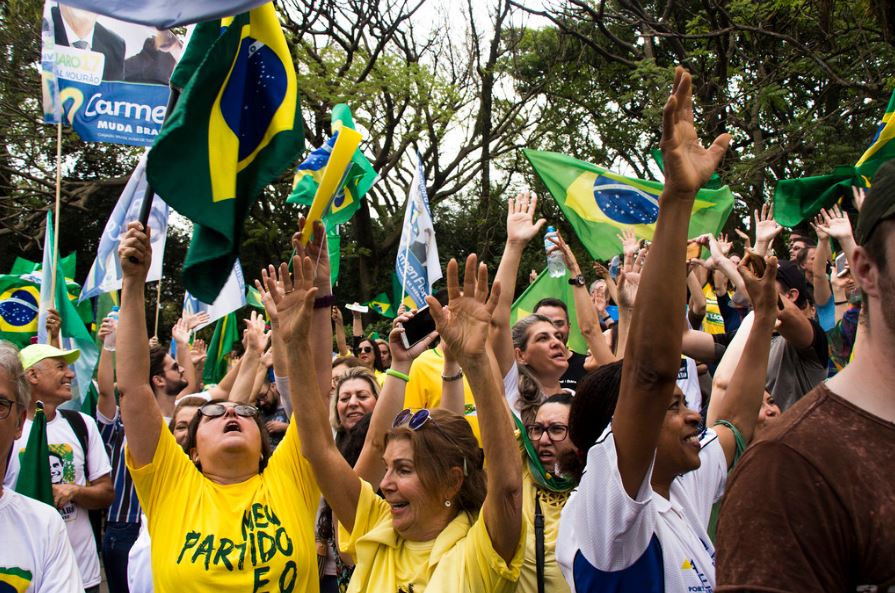
Supporters of Jair Bolsonaro on September 30, 2018 in Porto Alegre, Brazil. Editorial J / Flickr
It’s Election Day in the periphery of Santo André, a municipality in greater São Paulo’s industrial ABC region. A man in his fifties is selling caldo de cana, a sweet drink made from sugar cane, from his van. As he pushes the cane through the grinder, two men of a similar age, sitting on white plastic stools, chat enthusiastically. The topic is the same one that is on everyone’s lips today.
“I don’t like Bolsonaro, but at least he’ll give the bandidos [criminals] a beating,” says one. “And put an end to Bolsa Família,” the other pitches in, referring to Brazil’s famous conditional cash transfer program. “They don’t want to work, and if you take the money away they just go out and rob.” The first man points his two fingers out like he’s holding a pair of guns, a gesture popularized by far-right presidential favorite Jair Bolsonaro, whose extreme law-and-order platform could accurately be described as exterminationist. His friend imitates the action. All three men laugh. Still chuckling, the drinks seller hands over my drink and my change, “Thank you, have a nice day!”
That night, as the results came in, it was clear that Bolsonaro’s Social Liberal Party (PSL) party had been the big winner. Bolsonaro himself won 46 percent of the popular vote compared to 29 percent for the Workers’ Party (PT) candidate Fernando Haddad. It was a thumping win, but not the absolute majority he needed to avoid a second-round run-off, which will take place on October 28th.