Macri’s Dirty War
Mauricio Macri claims that expanding the Argentine military's power will fight drug trafficking. But it's more likely to repress social movements and threaten democratic rights.
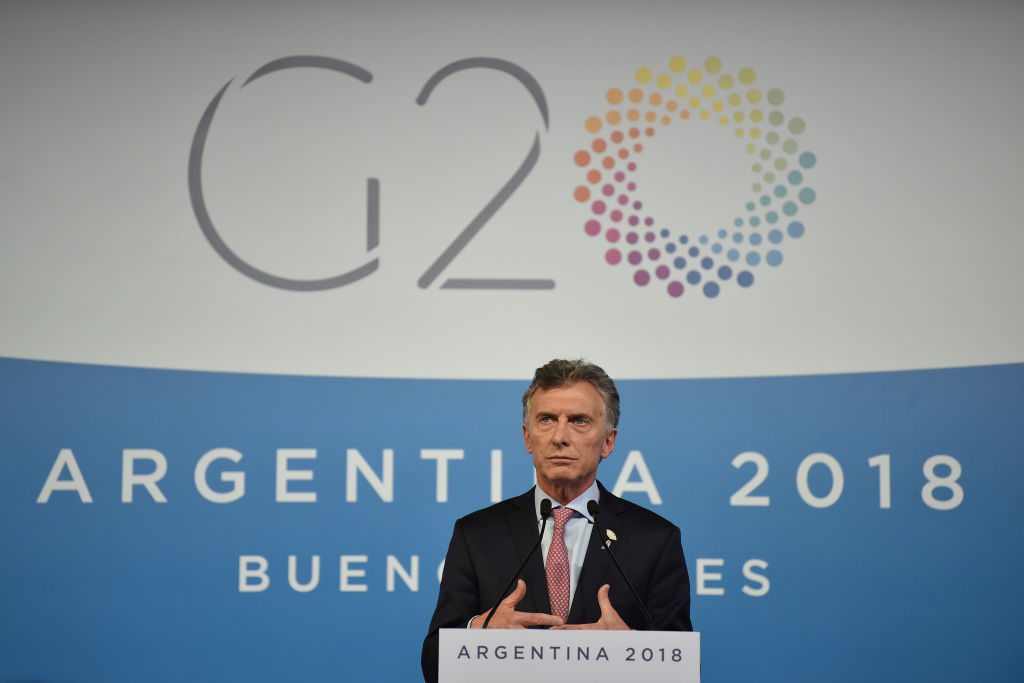
President of Argentina Mauricio Macri speaks during a press conference on day two of sessions of Argentina G20 Leaders’ Summit 2018 at Costa Salguero on December 01, 2018 in Buenos Aires, Argentina. Amilcar Orfali / Getty
The role of Argentina’s Armed Forces is being redefined in the wake of the passage of two new decrees that threaten to remilitarize the country. Decrees 683 and 703, passed on July 23 and July 31 of 2018, respectively, challenge the separation of internal security and national defense as defined by successive governments after Argentina’s democratic transition. The new decrees amplify the likelihood that the Argentinian Armed Forces can be deployed within the country against perceived domestic threats — and carry grave implications.
Decree 683 explicitly states that the national army can respond to any threat originating outside the country but that is present within Argentinian national territory, such as drug trafficking or international terrorism. It changes a 2006 decree that determined the Armed Forces’ mission as combating military threats originating in other countries. Decree 703, also known as the National Defense Directive, gives the Armed Forces the capacity to formulate strategies against organized crime and international terrorism, citing the increasing transnationalism of South American security issues, such as organized crime and the risk of international terrorism expanding to the region.
The move to broaden the scope of the Armed Forces’ mandate is no surprise considering the language of “military modernization” that President Mauricio Macri has employed since taking office in December 2015. Combating crime is one of his administration’s top priorities, emphasized during his electoral campaign. In his first speech to the Armed Forces as president, he argued that Argentina’s military must adapt to “twenty-first-century demands and requirements.” By this, he meant participating in UN peacekeeping missions, combating terrorism, and inserting climate change into the national security agenda. In his most recent speech to the Armed Forces in May 2018, he argued that the army should support the fight against drug trafficking and organized crime.