Pulling Rabbits Out of Hats
How a decade of crisis changed economics.
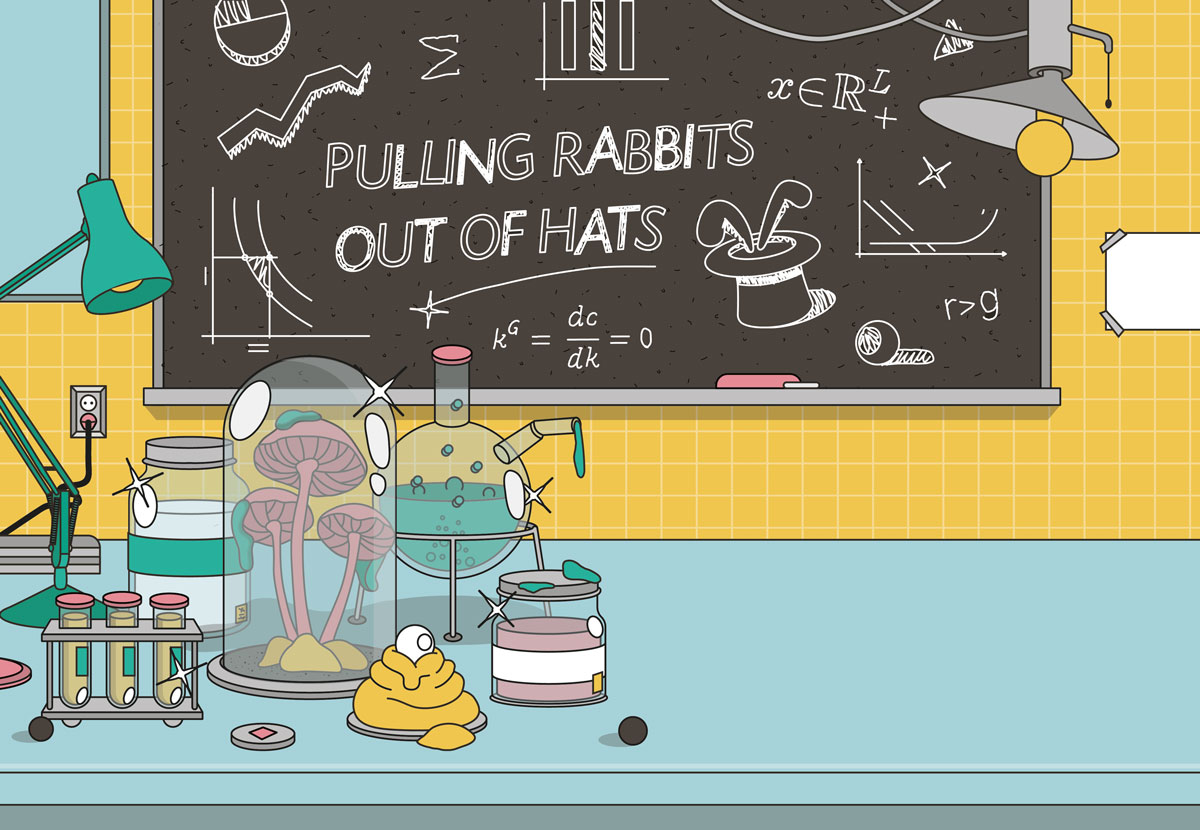
Illustrations by Mariano Pascual
Has economics changed since the crisis? As usual, the answer is: it depends. If we look at the macroeconomic theory of PhD programs and top journals, the answer is clearly, no. Macroeconomic theory remains the same self-contained, abstract art form that it has been for the past twenty-five years.
As Joan Robinson once put it, economic theory is the art of pulling a rabbit out of a hat right after you’ve stuffed it into the hat in full view of the audience. The development of theory since the crisis has followed this mold.
One prominent example: Immediately after the crash of 2008, Paul Krugman, writing in venues like the New York Times, announced that with interest rates at their zero lower bound, we had entered the Alice-in-Wonderland universe of the “liquidity trap” — a world in which the conclusions of orthodox economics are turned upside down and “perverse” Keynesian claims become true. Fiscal policy was now effective, printing money posed no danger of inflation, trade deficits really did cost jobs, and so on. He explicated these ideas using the “IS-LM” model found in undergraduate textbooks — a simple device that hasn’t played a role in professional academic work in decades.