Why the Media Is Pro-Israel
An accurate telling of the Israel-Palestine conflict would tell of Israel violently colonizing Palestine with US support. Instead, media outlets present fables in which both sides are equally to blame.
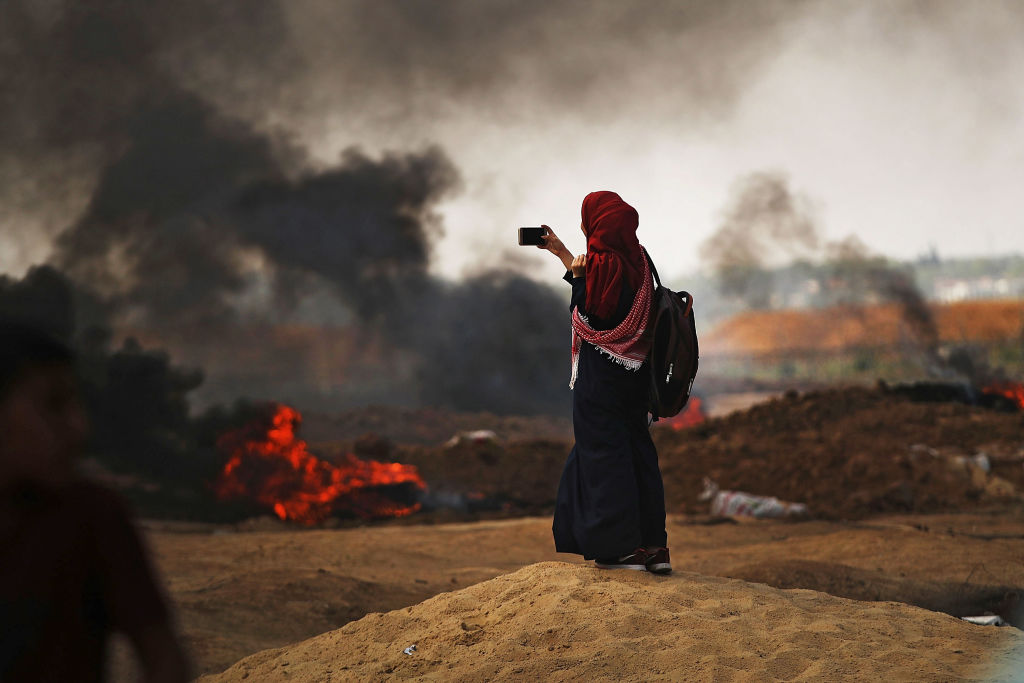
A Palestinian woman documents the situation at the border fence with Israel as mass demonstrations continue on May 14, 2018 in Gaza City, Gaza.Spencer Platt / Getty
To understand why Western news outlets proffer narratives about Palestine-Israel that favor Israel, it is necessary to consider these media outlets’ political function. Joseph Uscinski explains that, “There is no doubt that systemic economic forces such as the need to sell advertising space and manage expenditures, determine the actions of news firms.”
Multiple studies demonstrate that the commercial orientation of news media shapes its content. An early 1990s academic survey of editors at daily newspapers finds that just under 90 percent reported that advertisers attempted to influence the content of stories appearing in their papers and 90 percent of them had advertisers apply economic pressure to them because of their reporting; 37 percent admit to capitulating to advertiser pressure.
Another academic survey of daily newspapers, this one published in 2007, finds that there are “frequent conflicts between the business side and the journalism side of newspaper operations” and that “advertising directors are willing to appease their advertisers, and are also willing to positively respond to advertisers’ requests.” The survey suggests that this problem is particularly acute at chain-owned newspapers, which are especially prone to compromising editorial integrity to either please their advertisers or keep from offending them. A similar problem exists in television, where polls of network news correspondents say that nearly one-third feel directly pressured to report certain stories and not others because of owners’ or advertisers’ financial concerns.