Germany’s Governmental Crisis
- Zachary Murphy King
A regional party in Germany is flexing its muscles and shifting the country's politics significantly to the right. Is Angela Merkel’s supremacy coming to an end?
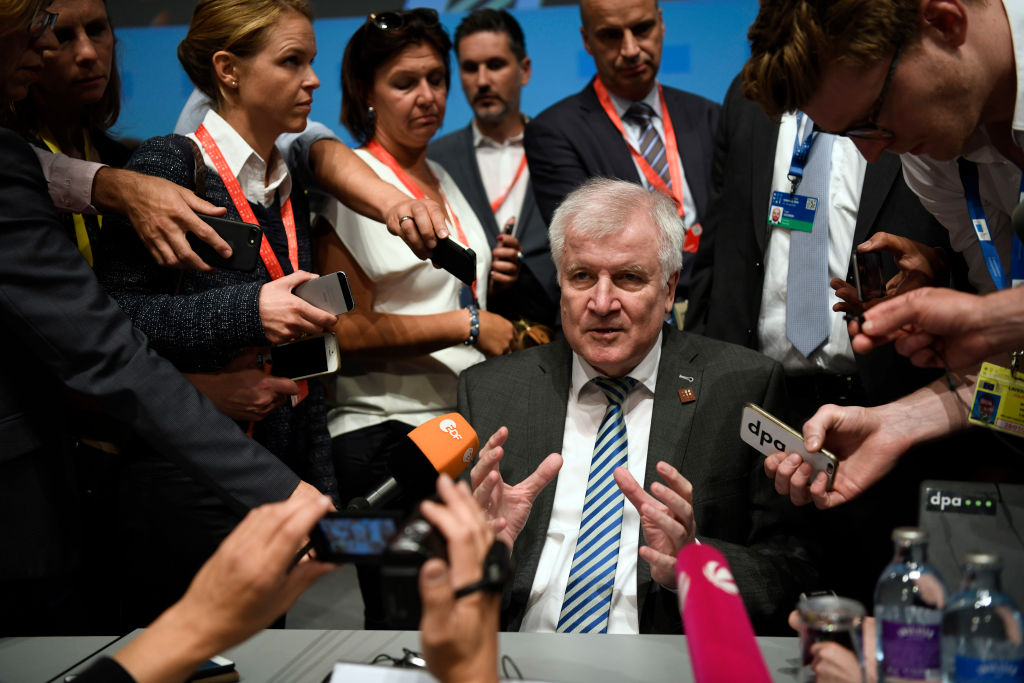
German interior minister Horst Seehofer speaks with media after a press conference during the European Union member states’ interior and justice ministers conference on July 12, 2018 in Innsbruck, Austria. Andreas Gebert / Getty
German politics doesn’t seem to be following the usual rules. Having just reached one hundred days in office, last week the new coalition government seemed to be teetering on the brink of collapse. Perhaps rather predictably, the immediate trigger for the crisis centered on immigration.
Germany’s interior minister Horst Seehofer, a member of Bavaria’s center-right CSU, announced that he had drafted an immigration “master plan” designed to establish stricter laws to “secure” the country’s national borders. Yet his sixty-three-point plan long remained unpublished, and his party, like Angela Merkel’s CDU (with which it has long had a national power-sharing agreement) and their common coalition partner, the Social Democrats, knew little of what he was proposing.
The only thing observers managed to learn from the flurry of government press conferences held on the topic was that Merkel would agree to sixty-two-and-a-half points from Seehofer’s “master plan.” The half-point discrepancy owed to the question of whether refugees already registered in other EU countries (such as Italy or Hungary) could cross the border to Germany and apply for asylum.