Forgetting and Remembering
Pulitzer Prize–winning novelist Viet Thanh Nguyen on the self-serving stories the US state tells about the Vietnam War.
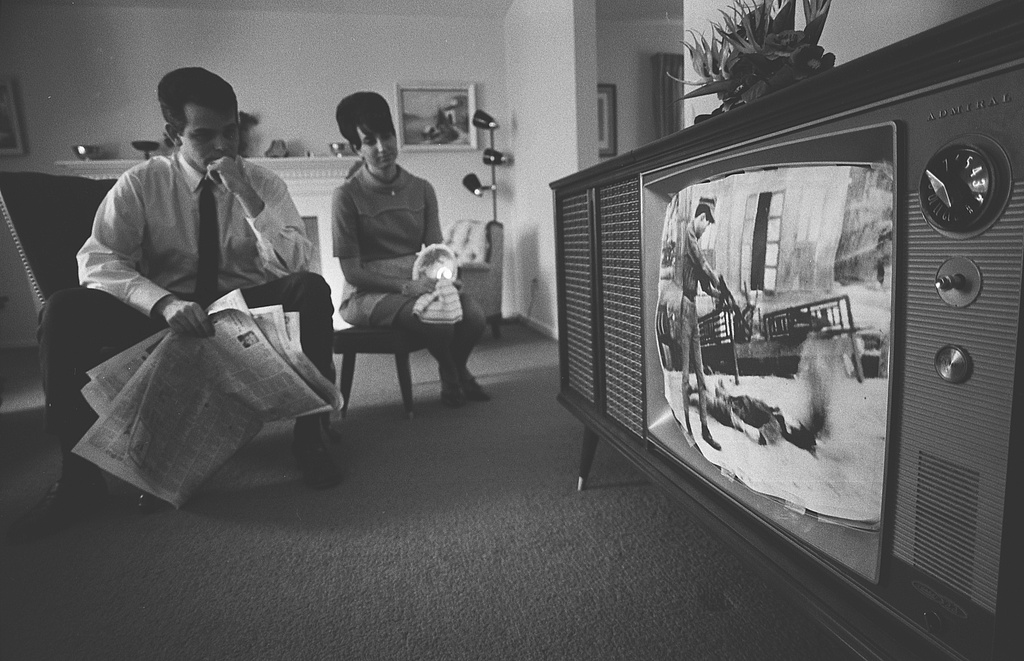
A man and a woman watching film footage of the Vietnam War on a television in their living room in 1968. Warren Leffler / Library of Congress
“I come here mindful of the past, mindful of our difficult history,” Barack Obama said during a May 2016 visit to Vietnam, “but focused on the future — the prosperity, security, and human dignity that we can advance together.” Such a sentiment, a seeming acknowledgment and an attempt at reconciliation, has become commonplace among Americans; the Vietnam War no longer casts a dark cloud over the nation’s consciousness.
This shift in rhetoric is accompanied by the United States’ reinvigorated campaign to establish Vietnam as an allied, capitalist bulwark against China — part of Obama’s vaunted pivot to Asia. The United States has sought to promote neoliberal economic policies through trade deals and sponsorship of a private university (Fulbright University Vietnam), while also lifting a decades-long ban on the sale of military equipment to Vietnam.
Against such neoliberalization, false reconciliation, and historical amnesia, Viet Thanh Nguyen, author of the 2015 Pulitzer Prize–winning novel The Sympathizer, is waging a literary battle on behalf of the Vietnam War’s forgotten victims.