Goodbye and Good Riddance, Robert Mugabe
Robert Mugabe was no socialist. He was a man obsessed with his own power and control.
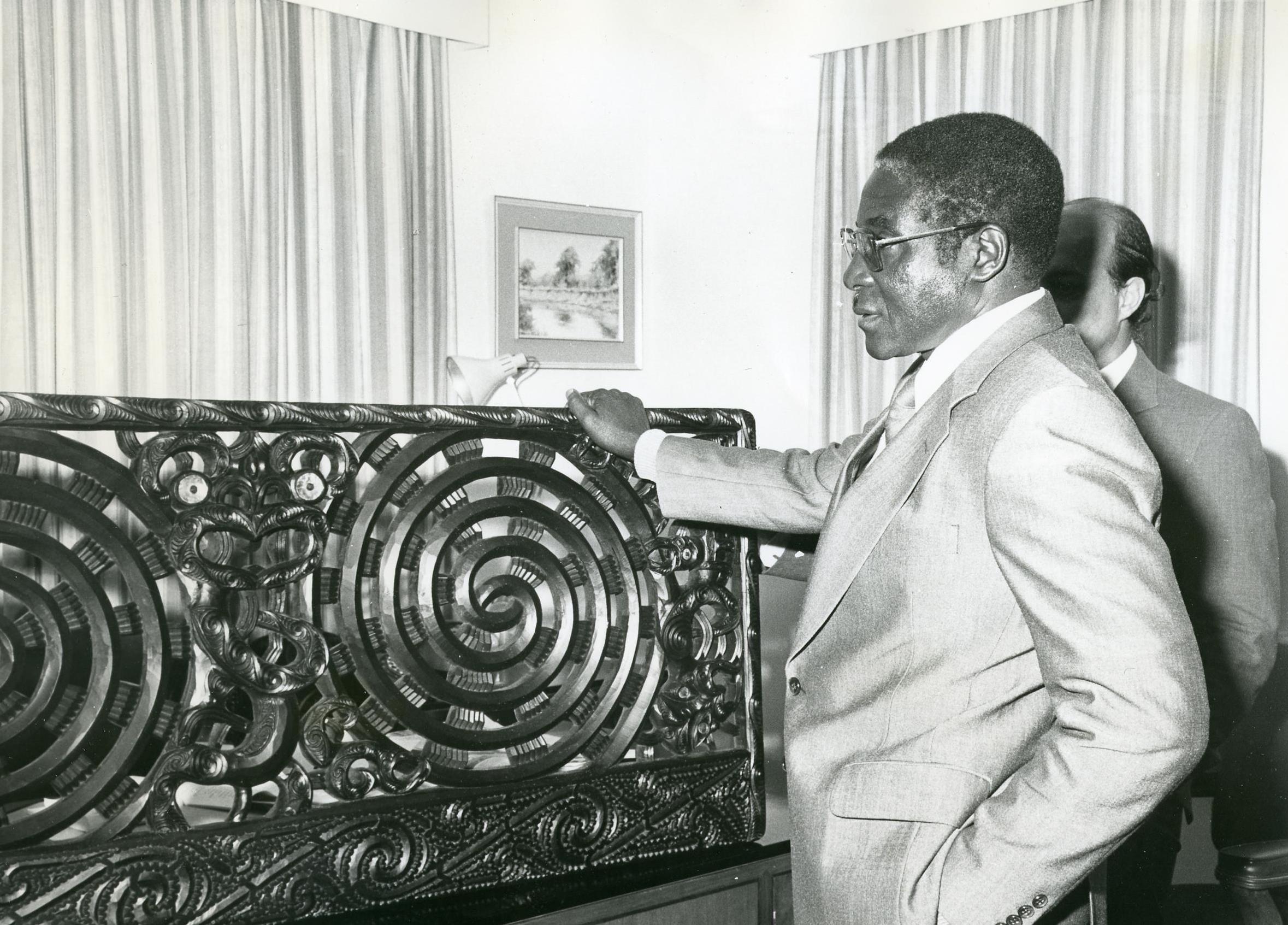
Robert Mugabe admires a Maori carving the New Zealand government gifted to the newly formed nation in 1980. Archives New Zealand / Flickr
When the history of Robert Mugabe is written, it will not be about a black man raised by a single mother, who defied all odds in racially segregated Southern Rhodesia to pursue an education at the highest levels. Neither will it be about an articulate black African teacher-turned-politician, who spent around a decade in prison for challenging white colonial racism and working for the betterment of black Zimbabweans. It will be about the four decades Mugabe was at the helm in post-colonial Zimbabwe, in which his rule was anything but admirable.
As a young politician in the late 1950s and early 1960s, Mugabe was by no means the most prominent of the black nationalists fighting white colonial rule. Neither was he the most motivated. He was, however, the most eloquent. For a clique of educated black elites, whose political and societal outlook was fashioned in mission schools, Mugabe was the man of choice to convey the message to white rulers — in voice and comportment — that blacks were no longer “uncivilized tribesmen.” They were sophisticated enough to deserve the franchise.
In everyday manners and air, Mugabe was an “English man” who spoke their language in the shapely tone of an eloquent and “cultured” gentleman. It is no wonder that when he arrived on the nascent nationalist scene, fellow nationalists noticed his gift of gab and appointed him publicity secretary in their organization, the National Democratic Party.