Not Just an Artifact
The Russian left doesn't just belong to the past. It can use the surge around Alexei Navalny to grow a new independent movement.
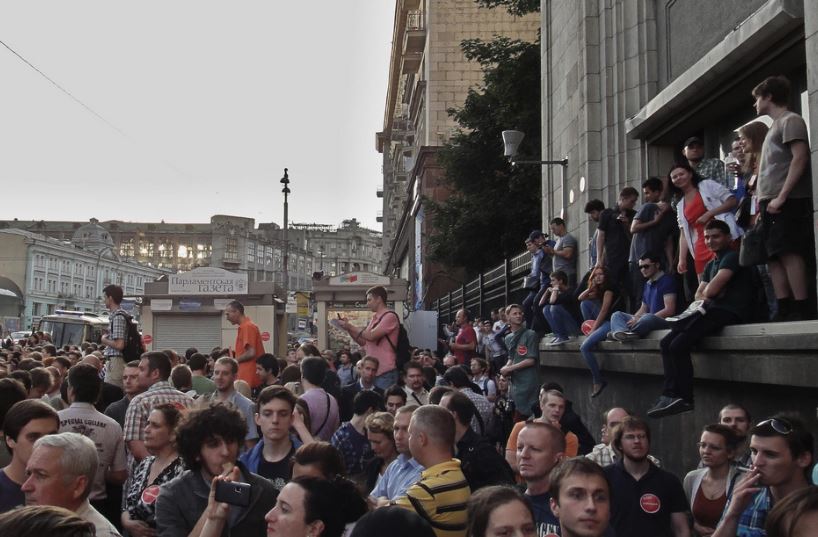
A rally in support of Alexei Navalny in Moscow, Russia, in 2017. (Vladimir Varfolomeev / Flickr)
This year, the Russian anti-corruption and opposition politician Alexei Navalny initiated nationwide protest rallies in eighty cities on March 26 and more than one hundred on June 12. Both days of action demonstrated a sharp uptick in popular discontent and revealed the growing politicization of young people and residents of provincial cities. Indeed, many of the protesters who joined Navalny’s rallies didn’t participate in the mass demonstrations that were mostly concentrated in Moscow in 2011–12. These newly minted activists took to the streets to fight the nation’s pervasive corruption, growing economic inequality, and crumbling living standards.
This popular upsurge caught the Russian left flatfooted. Though many committed activists and adherents remain in the movement, repression has weakened it, and disagreements over the annexation of Crimea and the Russian intervention in Ukraine have divided it. How should the Russian left — not to mention the international socialist movement — respond to this upsurge and, especially, its leader?
For many American and European leftists, the Russian left appears as an artifact. They valorize Russia for its revolutionary past — taking its desires and achievements as a source of inspiration and its mistakes and tragedies as a cautionary tale — but reduce its contemporary manifestation to a caricature.