A Brief History of American Health Reform
In order to win universal health care, we have to understand what — and who — we're up against.
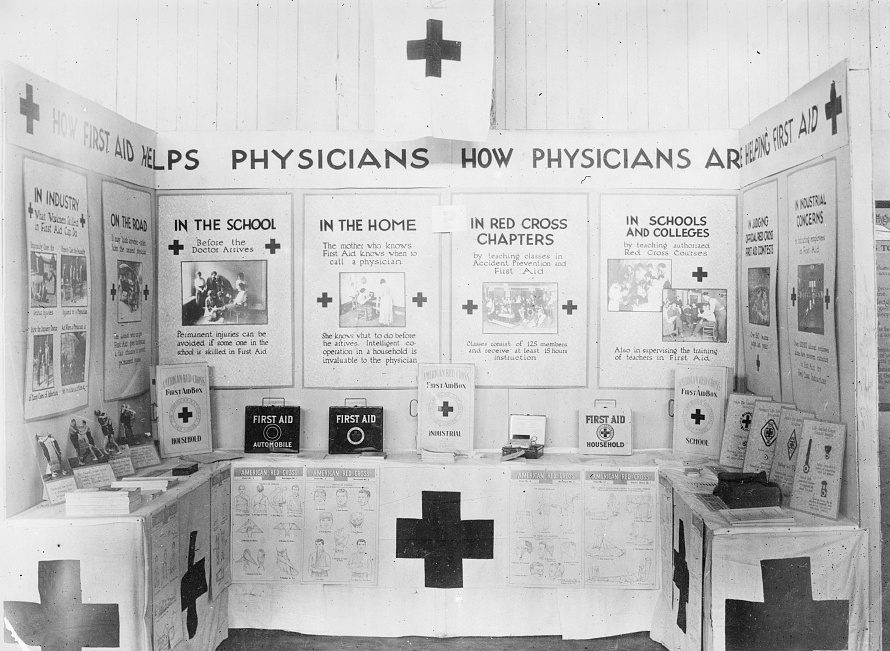
A Red Cross first aid exhibit at a 1921 American Medical Association meeting in Boston. Library of Congress
It is a simple fact of politics in capitalist democracies that private interests shape, and often simply decide, public policies. Many issues of broad or collective concern — investment, employment, the allocation of resources — are made outside the political arena altogether, with policy called in only to mop up failures.
Both electoral politics and the legislative process in the United States are notoriously capital-intensive, the fate of candidates and policies largely determined by private demands and private resources. Some, as the economist Anthony Downs famously observed in 1957, “are more important than others politically, because they can influence more votes than they themselves cast.” The result, as recent research has laid bare, is not just the glorious irrelevance of the median voter, but a seemingly impenetrable engine of elite domination generating both stark inequality and policies designed to make it starker.
All of this is especially true, and especially destructive of the public good, in the American health care system — a monstrosity that gobbles up nearly a fifth of the country’s gross domestic product while dramatically outspending and underperforming its international peers.